The Slow Light of the Faroe Islands
Perched at the edge of the North Atlantic, the Faroe Islands exist in a perpetual soft-focus dusk — a place where green cliffs plunge into silver water and time moves at the speed of weather.
The Slow Light of the Faroe Islands
Light does not behave here the way it does elsewhere.
In most places, the sun is a fact. It rises, it illuminates, it sets. In the Faroe Islands, light is more of a suggestion — a luminous uncertainty that filters through Atlantic cloud banks and arrives on the hillsides softened, diffused, as though the sky itself is made of frosted glass.
This is not a failure of weather. It is the whole point.
Arriving Into Green
The first thing you see, dropping through cloud on the approach, is green. Not the polite green of managed parks, but a ferocious, saturated green — the green of moss that has had centuries to perfect itself, of grass so dense and so wet it seems almost to vibrate.
The islands rise from the North Atlantic like the exposed spines of something ancient and patient. Eighteen of them, give or take the islets, arranged in a loose archipelago between Norway and Iceland, roughly equidistant from everywhere and belonging, truly, to none of it.
The villages cling to the fjord edges the way barnacles cling to rock: by conviction more than any obvious logic.
Saksun in the Rain
There is a village called Saksun that sits at the head of a tidal lagoon, accessible by a single road that winds through mountains the color of pewter. On the day I visit, it is raining the horizontal Faroese rain — not falling so much as arriving from the side, purposeful and cold.
The church is small and white and alone on a hill above the water, as though it walked to the edge to think and simply stayed. Its red roof is the only warm color in a landscape of grey, green, and the particular silver-brown of wet grass.
The lagoon below changes shape with the tide. At low water, you can walk across black sand to the open Atlantic, where the waves come in long and slow from a fetch of three thousand miles, spending themselves completely on this single shore.
The sound they make is the sound of something finally finishing.
The Cliffs at Trælanípa
To stand at the edge of Trælanípa is to recalibrate your understanding of scale. The cliff drops nearly 142 meters straight into Sørvágsvatn lake, which itself appears, in photographs, to hover impossibly above the sea — a visual trick of perspective that makes the landscape seem constructed, unreal, dreamed.
In person, it is more vertiginous still.
The wind here has opinions. It presses against you from the west with a steady, indifferent force, pulling at jacket hems, flattening the grass into silver-green waves that roll back toward the hills. Fulmars wheel on the thermals below the cliff edge, calling in their clipped, mechanical voices, entirely unbothered by the drop.
The lake above the sea. The bird below the cliff. Everything in the Faroes seems to exist slightly outside the expected order of things.
The Hour of Horizontal Light
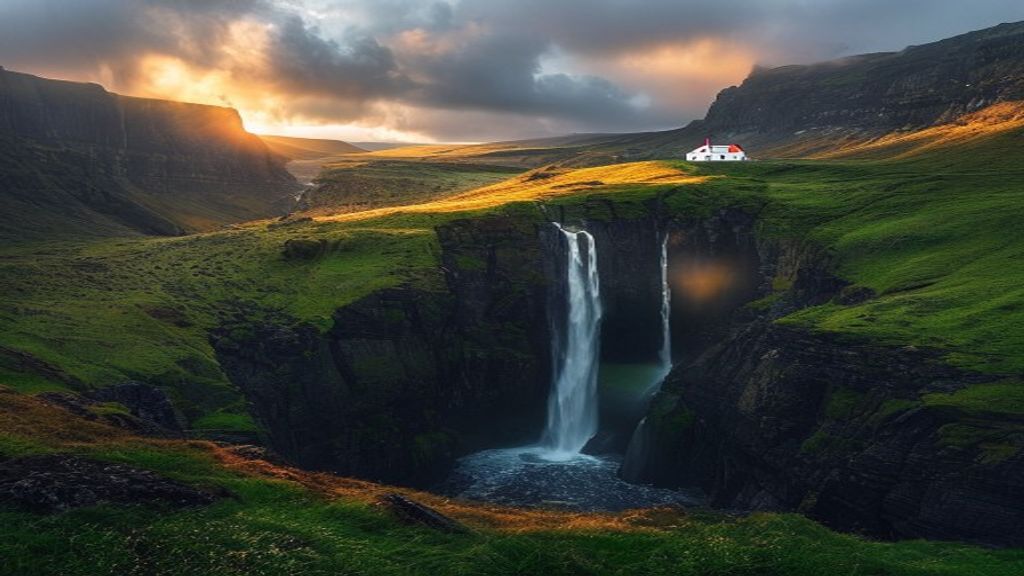
In summer, the sun in the Faroes barely sets. It skims the horizon sometime after ten, dragging out a golden hour that lasts for the better part of two hours before giving way not to darkness but to a luminous, pearl-colored dusk that sits on the mountains like a breath held.
This is the light that photographers come for and struggle to describe afterward. It makes the waterfalls — and there are waterfalls everywhere, threading down every cliff face, running off every road — glow from within like white silk held up to a lamp.
It makes the grass look like it has been lit from underground.
It makes you sit on a damp hillside and not want to move until it’s gone, and then feel, when it finally fades, that you have witnessed something that shouldn’t have been free.
What Remains
The Faroes ask nothing of you except attention. There are no ancient monuments, no famous cuisines, no checklist of monuments to photograph and move on from. What they offer instead is the persistent, clarifying presence of weather and water and a green so green it almost has a sound.
You carry it with you when you leave. A certain quality of light. The weight of horizontal rain. The particular silence of a hillside at the edge of the North Atlantic, with nothing between you and the horizon but the slow, enormous patience of the sea.