The Salt Flats at the End of the World
On the Bolivian altiplano, the Salar de Uyuni erases every horizon and turns the sky into the ground — a place so vast and so silent that the self grows small, and grateful for it.
The Salt Flats at the End of the World
Somewhere above four thousand metres, the world forgets its own rules. The air grows thin enough that your thoughts arrive slightly delayed, like a radio signal bouncing off the ionosphere. The horizon, that reliable seam between earth and sky that every human being has navigated by since the beginning of consciousness, simply ceases to exist. You are standing inside a mirror the size of a country.
This is the Salar de Uyuni. This is where the world ends, and begins again, and you cannot tell the difference.
Arrival: The White Desert
The road from Uyuni town crosses a dry scrubland of thorned brush and rust-coloured dust, and then, without ceremony, the salt begins. It starts as a pale crust at the road’s edge, as if someone has spilled something, and then within a kilometre it has swallowed everything — ten thousand square kilometres of crystallised salt stretching in every direction, blinding white under the high-altitude sun, patterned in perfect hexagonal tiles that the earth itself has drawn, each polygon outlined by a thin raised edge of salt crystal.
The first thing you notice is the silence. Not the silence of a room with the door closed, but the silence of an ocean with no waves — a total, directional absence of sound that makes your ears work harder, reaching for something to process. The wind moves here but makes no sound, because there is nothing for it to press against.
Rainy Season: The Mirror Appears
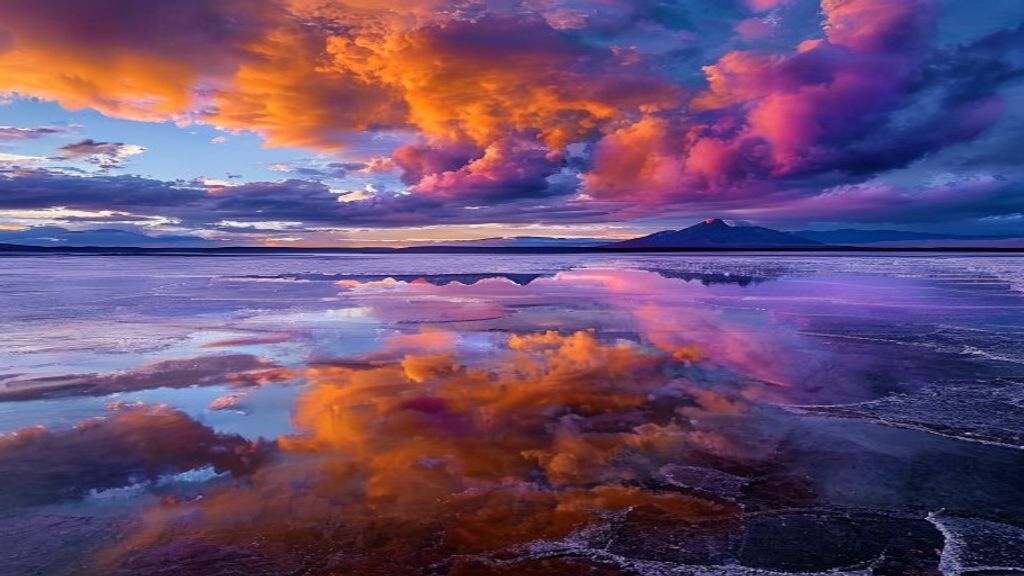
Come between January and March, when the seasonal rains dust the surface with a centimetre of clear water, and the Salar transforms into the world’s largest natural mirror. The sky descends. Or perhaps the earth ascends. A single cloud formation hangs above you and simultaneously below you, in perfect, breathless reflection, and you are suspended between two identical infinities.
The flamingos that feed at the salty shallows move across the water’s surface and simultaneously across the sky below them, their coral-pink wings outrageous against all that blank white and blue. They are impossibly, almost offensively beautiful — creatures that seem designed specifically to disprove the idea that nature is subtle.
You lie flat on the surface and press your palm down. The water is no deeper than a whisper. Beneath it, hard salt. Above it, everything else.
Sunset: The Hour of Impossible Color
At sunset, the Salar does what the Salar does, which is to make photographers weep quietly and philosophers question their life choices. The sky moves through colours that do not have agreed-upon names — the particular orange that lives between flame and rust, the specific purple that is neither grape nor violet, a green that appears for approximately ninety seconds in the high atmosphere and convinces you briefly that you are on another planet.
All of it reflects. All of it doubles. The sun sets in four places simultaneously — in the west, and in the east where the salt throws it back, and below you in the water, and above you in the sky, and somehow also in the space inside your chest where large feelings live.
You take photographs knowing they will not work. They never work. The Salar defeats photography not because it is beyond beauty, but because beauty at this scale requires the participation of your whole body — the cold altitude air in your lungs, the ache in your knees from the long drive, the slight unreality of oxygen debt. The image alone is only ever a rumour of the real thing.
Morning: Salt and Stillness
At night, the temperature drops sharply and the water surface freezes to a thin crackled glaze, like the skin on cooling caramel. By morning, before it melts again, you walk across it in the pre-dawn dark and it makes a sound like walking across a thousand whispered secrets, each footstep a small, irreversible crunch.
The stars above the Salar are preposterously bright. At this altitude, with no city light for hundreds of kilometres in any direction, the Milky Way is not a suggestion but a structure — a cathedral ceiling of cold fire that makes the horizon glow faintly even at two in the morning. You stand beneath it feeling neither small nor large, but exactly the right size for the universe that made you.
That feeling is why people come here. That is the secret the salt flats keep.