The Salt Flats at the Edge of the World
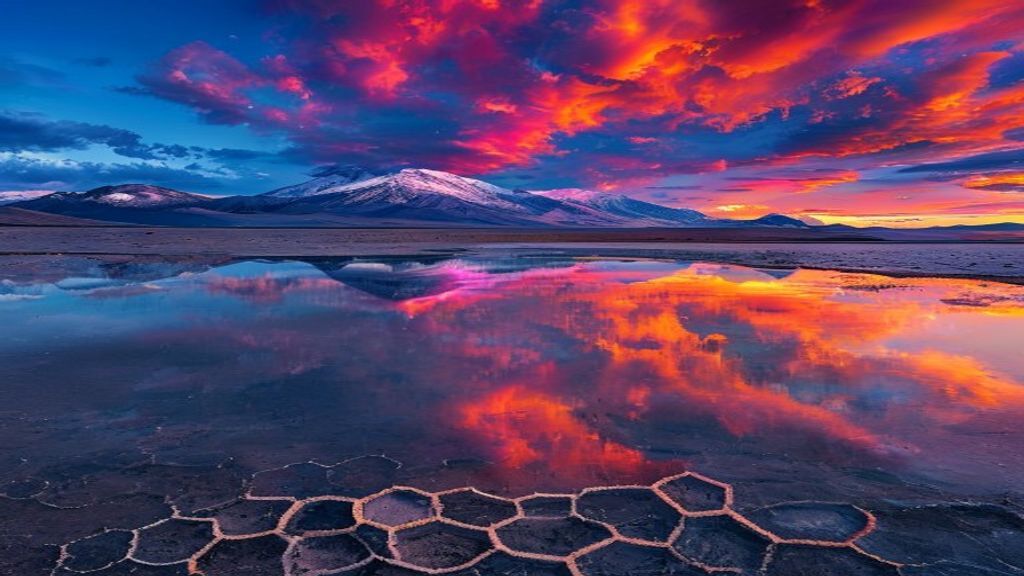
Bolivia's Salar de Uyuni during the rainy season becomes the world's largest mirror — a place where sky and earth dissolve into each other and the horizon ceases to exist.
The Salt Flats at the Edge of the World
There are places on earth that make the language of description feel small and inadequate — that force you to put down your metaphors and simply stand inside the experience, breathless and humbled. Bolivia’s Salar de Uyuni is one of those places. At 10,582 square kilometers, it is the largest salt flat on the planet, a white expanse so vast and so geometrically perfect that it has been used to calibrate satellites. But statistics do nothing for it. Numbers cannot touch what it does to you.
Come in the rainy season — November through April, when a thin sheet of water covers the surface — and you will see something that redefines your understanding of what the world can look like.
Arriving at Dawn
The drive out from the town of Uyuni begins in darkness. The altiplano at 3,600 meters above sea level is cold before sunrise in a way that is entirely serious — not the brisk cold of a northern autumn morning but the deep, lung-filling cold of high altitude, of thin air and open sky. In the 4x4, the heater works intermittently. Outside, the stars are extraordinary: the Milky Way visible as a physical structure, a river of light so dense and detailed it seems close enough to reach.
Then, slowly, the darkness ahead begins to change color. A thin line of violet appears along the eastern edge of everything. It widens to indigo, then to something that is not quite purple and not quite pink and has no name that I know of. And as the light grows, you begin to see it — or rather, you begin to see the sky — reflected perfectly, impossibly, in the water below.
The Mirror World
In the wet season, a few centimeters of rainfall transform the salt flat into the world’s largest natural mirror. The effect is total and disorienting in the most profound and pleasurable way. The surface is so still, so perfectly reflective, that the horizon line vanishes. Sky and earth become one continuous image. The clouds drifting above are the clouds drifting below. The mountains at the distant edge of the flat — the volcanic peaks of the Andes, snow-capped and immense — appear both above and beneath you simultaneously, as if the world has been folded along some invisible crease.
Your guide stops the vehicle and cuts the engine. You step out onto the shallow water — a millimeter deep, no more, warm now as the sun climbs — and feel the salt crystals crunching faintly beneath your boots. The sound carries strangely in this space where there is no wind, no obstacle, nothing to absorb or deflect it. Your own breathing sounds loud.
And then you look down.
You are standing in the sky.
The Light That Changes Everything
Salar de Uyuni is a place that reinvents itself every hour as the light moves. At sunrise, the reflected clouds are pink and gold and the whole world is suffused with a warmth that feels almost edible — you want to breathe it in, hold it, keep it somehow. By mid-morning, as the sky deepens to its altitude blue (a blue that is darker and more saturated than any sea-level sky, as if the altitude has compressed it, concentrated it), the flat becomes monochrome and absolute: white below, blue above, the line between them erased.
At midday, when the sun is directly overhead, the flat turns silver — a blinding, total silver that the eye can barely hold. Shadows disappear. Depth disappears. You become a silhouette moving through pure light.
And at sunset — return for sunset if you return for nothing else — the sky performs. The Andean atmosphere, thin and clean, produces colors that seem to have been invented specifically for this place: mauves and burnt oranges, a pink that deepens to magenta, a final flare of gold along the western edge before the cold rushes in and the stars begin their reappearance one by one.
What the Silence Teaches
Spend long enough on the salt flat and the silence begins to work on you. Not the silence of emptiness — the flat is never empty, it is full of light and sky and the distant presence of mountains — but the silence of scale. Of being reminded, gently and absolutely, of your own smallness.
There is something clarifying about standing in a place where the earth has become the sky and the sky has become the earth, where every direction looks the same and every direction looks like everything. It does not make you feel lost. It makes you feel, strangely, located — placed precisely in the present moment, in this body, in this light, in this particular and unrepeatable version of the world.
You drive back as the darkness returns. The stars come out again, the same stars, the cold the same cold. But something has shifted — some internal geography rearranged. Uyuni does that. It shows you the world folded open, and after that, nothing looks quite flat again.