The Salt and the Sky: Drifting Through the Sahara's Edge
At the boundary where Morocco's last villages dissolve into an ocean of sand, time loses its grip and the world reduces itself to three perfect things: light, silence, and dune. A journey into the ancient quiet of Erg Chebbi.
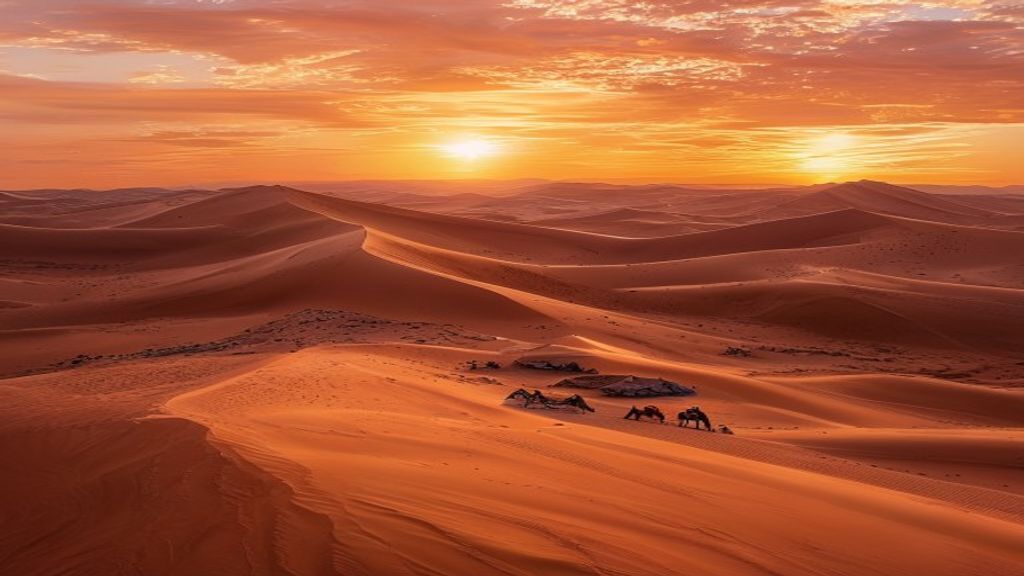
The desert does not ease you in. One moment there is a road — cracked asphalt, a petrol station, a boy selling argan oil from a plastic table — and then, with a single turn, there is nothing. Nothing except sand the color of turmeric rolling to every horizon, and above it, a sky so vast and blue it feels structural, load-bearing, the ceiling of the world.
This is the Sahara. Or rather, this is the edge of it — Erg Chebbi in southeastern Morocco, where the dunes rise to nearly 150 meters and the silence has a texture you can almost press between your fingers.
Arrival at the Hour of Gold
Every traveler arrives at the dunes wanting the same thing: to see them at sunset, when the light goes horizontal and the shadows between the ridgelines carve the sand into something sculptural, impossible, painted. And every traveler, when they finally stand there — shoes off, feet sinking into warm sand, the whole theatre of orange and rose and deep violet playing out across the sky — forgets entirely that anyone else has ever seen it before.
The dunes do that. They make the ancient feel personal.
The light changes faster than you expect. One minute the highest ridge is lit like hammered copper, glowing from within. The next it has cooled to the matte purple of a bruise, and the first stars — sharper here than anywhere — have already appeared above it.
Night Without Ceilings
Sleeping in a desert camp means sleeping under a canopy of stars so dense and layered it makes the sky seem close. The Milky Way arcs overhead from dune to dune, a smear of cold light that the Berber guides call by a name that translates, roughly, as the river the camels follow home.
At 3 a.m., the temperature drops to something you don’t expect. You pull a rough wool blanket tighter and listen: the wind has picked up, moving over the dune crests with a sound like distant breathing. A camel somewhere in the dark groans softly. The fire has gone to embers.
You lie on your back and feel very small, and it is the best you’ve felt in months.
Before the World Begins Again
The alarm — if you bother with one — is unnecessary. The desert wakes itself at a particular blue-gray moment before sunrise, when the air carries the last of the night’s cold and the sky at the eastern edge begins its slow blush from pewter to rose to fire.
Climbing the nearest dune in pre-dawn darkness is an act of faith. Each step forward slides you half a step back, the sand shifting and whispering beneath bare feet. Your thighs burn. You breathe hard. And then you are at the top — wind-scoured, cold, standing on a blade of sand — and below you in one direction is an infinite dark ocean of dunes, and in the other, a horizon bleeding red-gold, and the sun is rising out of Algeria like a slow, enormous promise.
The Road Back
The village of Merzouga, half-buried in sand at the dune’s foot, comes back into focus slowly — the call to prayer floating across the flat air, the smell of cumin and charcoal from a kitchen somewhere, a tethered goat in a courtyard casting a long, thin shadow.
You drink mint tea so sweet it coats your teeth. You are covered in a fine film of rust-colored dust. Your phone has no signal. The desert is already behind you, but it is also, somehow, still happening — a vibration in the chest, a recalibration of scale. You look at your hands and they are clean. You look at the road and it is straight and pale and it leads north, back toward everything ordinary.
You are in no hurry.