The Sahara at Sundown: An Ocean Made of Gold
As the sun drops behind the dunes of Erg Chebbi, the world's largest desert stages its most intimate performance — a symphony of color, wind, and absolute, humbling silence.
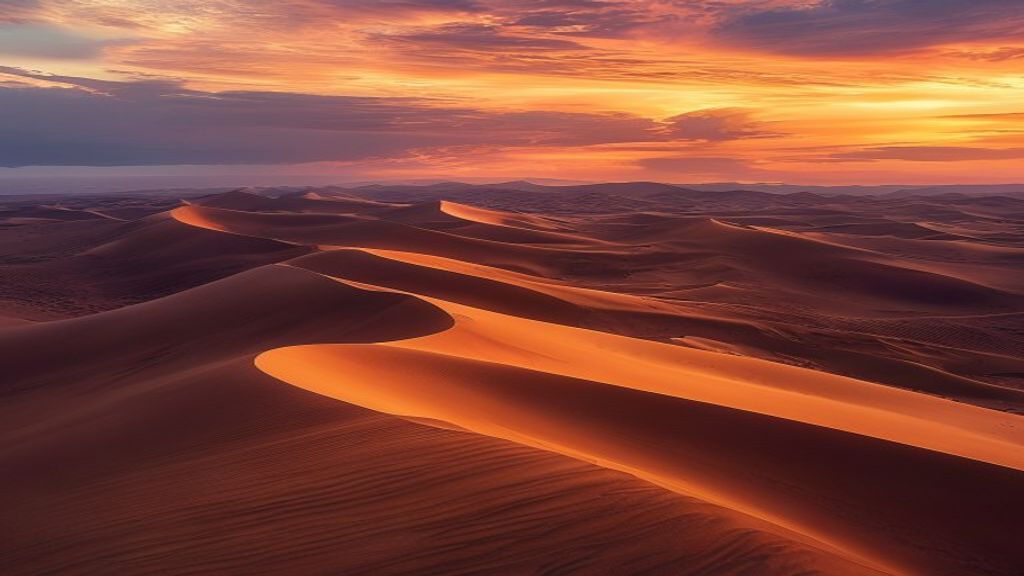
The Sahara does not ease you in. One moment you are on the edge of the small Moroccan town of Merzouga — diesel fumes, tagine smoke, the honk of a motorcycle — and then the dunes begin, and everything else ends. The desert does not transition. It simply starts.
The First Dune: Learning to Walk in Sand
You will climb the first dune poorly. Everyone does. The sand is not the pale beige of a beach; it is a deep, almost reddish gold, the color of raw honey held up to afternoon light. It gives beneath each step in a way that feels generous at first and then immediately punishing — two steps up, one step back, your calves burning, your breath short. The ridge line, which looked close from the bottom, retreats as you climb, a shifting, mirthful horizon.
But when you reach it — when you pull yourself up and over and stand on that paper-thin spine of wind-sculpted sand — the air leaves your lungs for an entirely different reason. Below you on the leeward side, the dune falls in a perfect, unbroken curve. Beyond it, more dunes, ranked like frozen waves, stretching south until they blur into the shimmer of distance. The wind has written its signature across every surface: delicate ridges, scalloped slopes, the ghost of a ripple preserved in the lee of a single half-buried stone.
Nothing here is still. The dunes move. Not today — not in any way you could measure or photograph — but over seasons, over years, the Sahara breathes and shifts and rearranges itself, a living thing that simply operates on a different timescale than anything that has ever worried you.
Golden Hour: The Desert on Fire
At four in the afternoon, the light is already changing. In the Sahara, the hour before sunset is not a winding down — it is a crescendo. The sun, angled low, rakes across the dune faces with a precision that would shame any studio photographer. Every ridge becomes a line of fire. Every hollow sinks into a shadow the color of ripe plum. The sand you walked through hours ago as a uniform gold is now a living palette: burnt sienna, deep ochre, a blush of rose pink on the windward slopes.
You find a spot on a high dune and sit. Below, the flat desert plain between the dune fields catches the last of the direct light in flashes — a scattering of small stones, each one throwing a shadow three times its own length. A single dry bush, leafless and skeletal, stands in the flat expanse. Its shadow stretches westward, impossibly long and thin, like the shadow of something important.
Nightfall: The Stars Arrive
It doesn’t get dark in the Sahara so much as the sky gets full. The transition is barely noticeable at first — a deepening of the blue above the eastern horizon, a first star that you’re not quite sure you’re really seeing. And then, in the twenty minutes between full dusk and true night, the sky fills with more light than you thought it could hold.
There is no ambient glow out here, no city on the horizon to bleed its light upward. The Milky Way appears not as the faint suggestion you’ve seen from countryside roads in Europe or America, but as a thing with mass and texture — a river of light so dense it seems to cast faint shadows on the pale sand below. You can hear your own heartbeat. You can hear the sand move.
The temperature drops fast — from the day’s fierce warmth to a cold that has teeth. But you don’t move. The desert has swapped its golden hour extravagance for something more fundamental, and you are not yet ready to stop receiving it.
Dawn: The Desert Begins Again
You wake before sunrise because something woke you — a silence so complete it reads as sound. Outside the nomad camp, the dunes are grey and blue in the pre-dawn, stripped of warmth, severe and beautiful. Then the ridge to the east flares amber, and the color moves down the dune faces like something poured, and the desert is gold again, as if it had never been anything else.
The Sahara does not ask you to understand it. It only asks that you pay attention.