The Sahara at First Light: A World Before Noise
Before the sun crests the dunes of the Moroccan Sahara, the desert holds its breath in a silence so complete it feels sacred. A photo essay about the hour when the world's largest wilderness becomes, briefly, the most intimate place on earth.
The alarm doesn’t need to ring. You are already awake.
Something in the body knows when darkness is about to break — a pressure change, a shift in the frequency of silence, a thinning of the black above the dunes’ ridgeline. You unzip the tent flap and the cold hits you like clean water. In the Sahara, the hour before dawn is the coldest thing imaginable. The same sand that scorched your feet at noon has surrendered every degree of warmth to the open sky, and now it glows faintly, blue-white, like the floor of a frozen sea.
You pull on a wool blanket and walk barefoot. The sand is impossibly fine. You leave no marks that last.
The Ridgeline
Climbing a dune before sunrise is an act of faith. Each step forward slides half a step back, and the top always seems farther than it looks. But you climb — thighs burning, breath smoking in the cold — because the ridgeline is where the Sahara reveals itself.
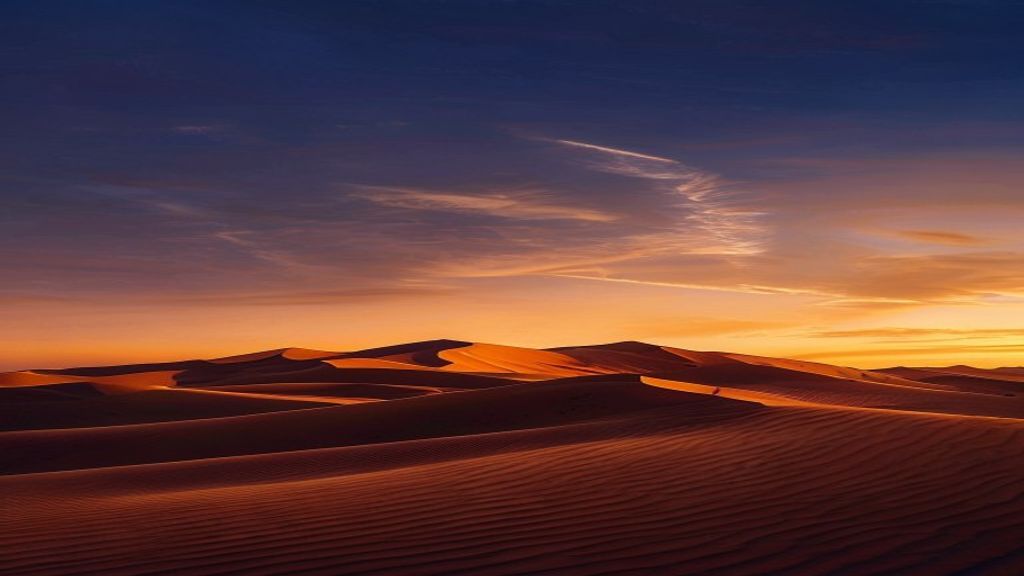
From the crest, the desert unfolds in every direction, rolling in massive frozen waves toward horizons that don’t exist yet. The sky to the east has just begun its negotiation with light: a deep indigo at the zenith, softening through violet to a thin line of amber resting along the top of the world. Venus is still burning. The dunes below are colourless shadows, defined only by edge and contrast.
Nothing moves. The wind has stopped, as if by agreement.
The Colours Begin
It starts with the sand.
Long before the sun appears, its light begins arriving in slant, raking horizontally across the desert floor, and the dunes — which were grey, then blue, then violet — become gold. Not metaphorically. A fierce, saturated, ancient gold, the colour of turmeric, of saffron, of things that predate language. Each grain catches the light individually. The Sahara sparkles.
Shadows lengthen in the hollows between dunes, a deep blue-purple that makes the lit crests glow even brighter by contrast. The geometry is extraordinary — parabolas, arcs, ridgelines sharp as knife-edges running for miles without interruption. Somewhere to the south, a dark line of acacia trees marks a wadi. Beyond them: more dunes. More silence.
A single beetle traces a wandering trail up the face of the nearest dune, its passage a brief, perfect calligraphy.
The Sun
When it rises, it rises fast. You forget this — how quickly the sun moves when you’re watching it. One moment it is a blinding sliver of orange resting on the horizon; the next it is a full disc, enormous and levitating, and the temperature has already shifted. The cold retreats. The sand begins its slow work of reclaiming heat.
The light is horizontal now, and everything it touches casts a shadow ten times its own length. A small rock becomes a monolith. A lone palm at the desert’s edge becomes a cathedral spire. The Sahara is performing scale again — reminding you how small you are, how short your visit, how old this sand.
The dunes here have been shaped and reshaped by the same winds for thousands of years. Empires rose and fell beyond their edge. Caravans crossed them carrying salt, gold, manuscripts. They recorded none of it. The desert has no memory. That is its mercy.
Descent
By the time you slide back down to camp, the cook has a fire going. The smell of khobz bread baking on cast iron and sweet mint tea brewing in a blackened pot rises through the dawn air. The camp — a handful of low tents, a tethered camel, a rug spread with glasses and a dented teapot — looks, in this light, like something from a manuscript illumination.
You hold the tea glass in both hands and face east. The sun is well up now, and the Sahara has begun its transformation back into something formidable, hot, and vast.
But for one hour, in the cold blue dark, it was yours. Quiet, golden, and impossibly close — a world before noise, a place before time, breathing in the same ancient rhythm it has always kept.