The Sahara After Sunset: Fire, Sand, and Absolute Silence
Once the sun drops below the dunes of the Moroccan Sahara, the desert becomes something else entirely — a vast, breathing dark filled with stars and the smell of woodsmoke and the oldest silence on earth.
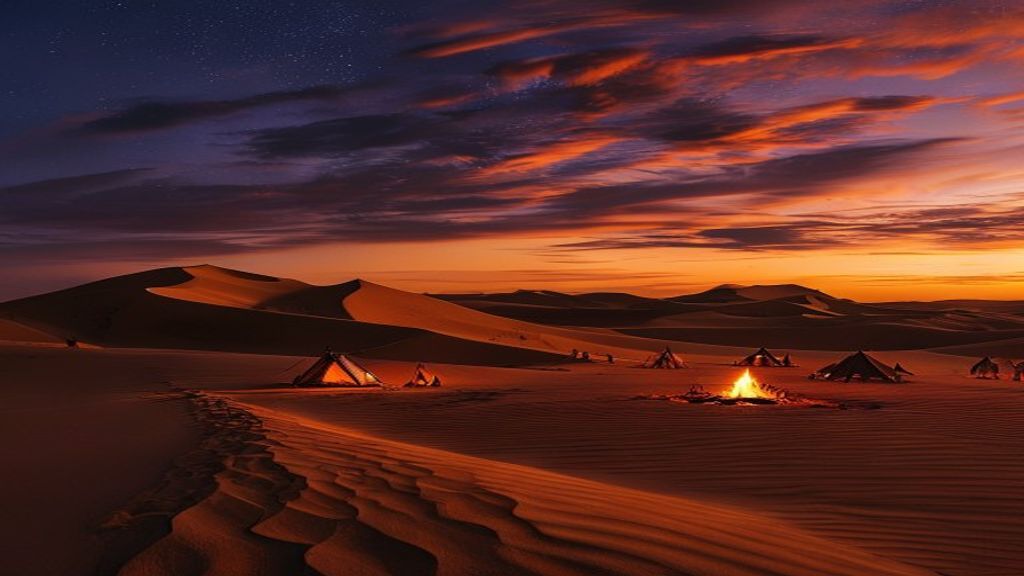
The Sahara does not ease you in. There is no transition, no gentle slope from the world you know into the world it is. One moment you are on a cracked asphalt road with petrol stations and roadside tagine shacks and the dusty normalcy of travel, and then the road ends, and the dunes begin, and the scale of the thing hits you like a physical force.
We had timed our arrival badly, or perfectly — depending on how you regard discomfort. We reached the edge of the erg, the great sea of sand dunes near Merzouga, in the last bruised hour of daylight, the sky already shifting from deep orange to violet above the dune line. There was no time to adjust. There was only the sand, and the sky, and the camels waiting at the bottom of the first dune like a sentence that needed finishing.
The Crossing at Golden Hour
Riding a camel across the Sahara at sunset is not romantic in the way the photographs suggest. It is lurching and slow, and the saddle is harder than it looks, and the camel makes sounds of profound personal grievance the entire way. And yet.
And yet the dunes in the last light of day are a colour that has no name in any language I speak. They are not gold and not amber and not copper, but something in the space between all three — a warm, saturated burning that seems to come from inside the sand itself, as though the Sahara has stored the whole day’s sun and is releasing it now, slowly, deliberately, in the last generous hour before dark.
The shadows on the dunes were extraordinary. Each ripple of wind-sculpted sand threw a precise, razor-edged shadow, so that the dune faces became maps of themselves — every ridge and hollow described in that interplay of warm light and cool blue dark. The wind moved across the surface and the map rewrote itself, constantly, silently.
Above us, the sky had become something operatic. Layers of colour stacked above the horizon — a burning orange at the dune line, then pink, then a deep and growing blue overhead that was already, in its upper registers, beginning to show the first pale stars.
The Camp: Fire and Cardamom
The camp appeared between two dunes as we descended — a handful of low Berber tents, their canvas warm with the light of lanterns, a fire already built and breathing in the open air between them. The smell reached us before we arrived: woodsmoke and something spiced, cardamom perhaps, or cumin, lifted on the cooling desert air.
The desert cools fast. Shockingly fast. Within twenty minutes of the sun’s disappearance, a jacket was not enough. The warmth the sand had hoarded all day radiated upward faintly underfoot, but the air above was clean and cold and carrying the faint mineral smell of a billion tons of ancient rock ground to dust over a million years.
We ate around the fire — lamb and preserved lemon and bread torn by hand — and talked less and less as the night deepened, because the desert was doing something to us. Stripping things away. The city brain, the notification brain, the brain that measures time in increments and worth in productivity. Out here, the only clock was the slow wheel of stars turning above us, and we had no appointments with any of them.
Midnight: The Stars Come Down
The Milky Way over the Sahara is not a metaphor. It is not a poetic expression. It is a structural feature of the night sky that you simply cannot see from anywhere near artificial light, and when you see it here — lying on your back on a dune in absolute dark, the sand still faintly warm against your spine — it reorganises something in your understanding of where you are.
The arch of the galaxy was so dense, so textured with light, that it threw a faint illumination on the dunes below it. The dunes glowed softly silver, their shadows now cast by starlight rather than sun. A shooting star crossed the whole width of the sky in two seconds and left a silence where the gasp should have been.
At some point I stopped trying to understand it and simply lay there, held between the warm sand below and the impossible sky above, aware of almost nothing except the fact of being alive, and the extraordinary improbability of finding myself here, at the edge of the largest desert on earth, under the oldest light in the universe.
What the Desert Returns to You
The Sahara takes things. It takes noise, and agenda, and the comfortable smallness of your daily concerns. It takes the illusion that time is something you manage rather than something you move through.
But it gives back something too. Perspective, yes — but that word is too thin for what actually happens. What it gives back is a kind of clarity that feels less like thinking and more like remembering. You remember that you are small and temporary. You remember that this is not a tragedy but a relief. You remember that the world was here long before you arrived and will be here long after, patient and enormous and gloriously indifferent, burning with light at its edges, cooling to stars at its centre.
We left at dawn, the dunes pink and new behind us. The road back appeared. The petrol stations appeared. The world reassembled itself around us, practical and loud.
But the silence came with us. It always does, if you let the desert in far enough.