The Quiet Hours of Kyoto
In the hour before the temples open and the tour groups arrive, Kyoto belongs to the mist and the moss and the slow turning of the world — a photo essay on finding stillness in Japan's ancient capital.
Kyoto does not reveal itself to those in a hurry. It never has.
The city was designed for contemplation — its gardens arranged so that beauty unfolds gradually, at walking pace, requiring patience of the eye. Come at dawn, before the souvenir shops roll up their shutters and the coach buses idle in the parking lots of Kinkaku-ji, and you will find the Kyoto that has always been here: composed, unhurried, and quietly devastating.
First Light Over the Sagano Bamboo Grove
The grove is best known from photographs: the towering columns of bamboo, the filtered light, the path curving out of sight. In those photographs, it is always empty. In reality, it almost never is.
Except at 5:30 in the morning in early May.
At that hour, the bamboo forest holds the light from yesterday. The sky above the canopy is a pale celadon — not quite green, not quite grey — and the stalks rise forty feet in columns so precise they suggest architecture rather than nature. The wind, when it comes, moves through the upper reaches of the grove in a sound that is half whisper and half percussion: a dry, papery rustling that the Japanese call soyo-kaze, the gentle breeze.
The path through the grove is empty. The gravel is raked. The only footprints are your own.
Fushimi Inari Before the Crowds
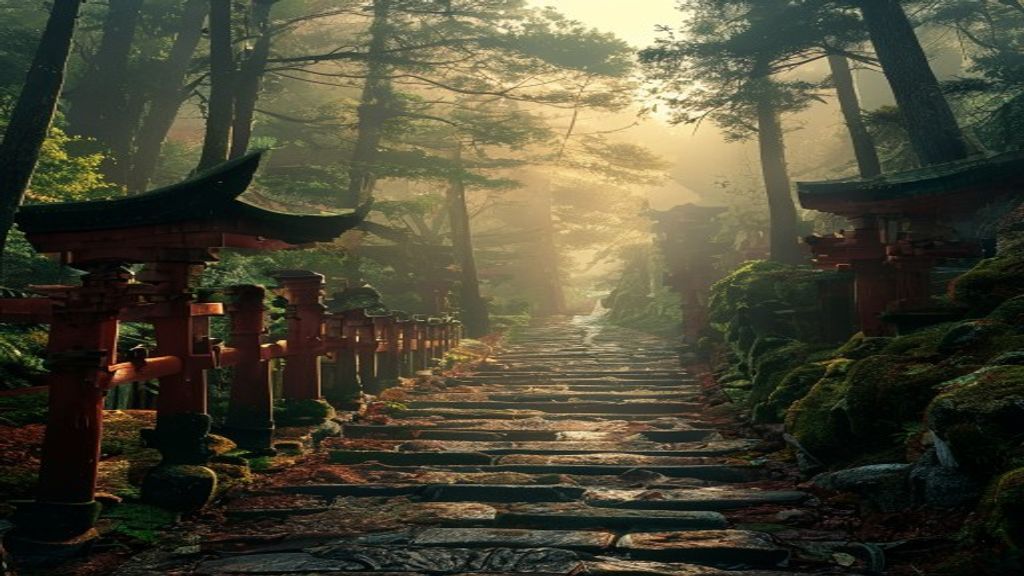
Two miles south of central Kyoto, the mountain path of Fushimi Inari Taisha begins its long, winding ascent through thousands of vermillion torii gates. By nine in the morning, the lower gates are thick with visitors. By six, the mountain breathes.
The torii here are not static. They are graduated — massive at the base of the mountain, growing smaller and more weathered as the path climbs — so that walking through them is like passing through time itself. The oldest gates at the summit have been swallowed by moss and shadow. Their vermillion has faded to something closer to rust, to blood, to autumn.
Morning mist pools in the hollows between the gates. Through the gaps in the forest, Kyoto lies below in the haze, its rooftops barely distinguishable from the low cloud. A fox — the sacred messenger of the Inari deity — crosses the path ahead and disappears into the cedar forest without looking back.
The Moss Garden of Saihō-ji
Access to Saihō-ji — the Moss Temple — requires advance permission and a modest ceremony upon arrival. It is one of Kyoto’s deliberate frictions, a reminder that some things must be earned rather than simply visited.
The garden within rewards the patience. Over one hundred and twenty varieties of moss cover the ground, the stones, the roots of ancient maples in an unbroken carpet of green so varied and deep it seems illuminated from within. There is chartreuse moss on sunlit stones. There is blue-grey moss in the shadow of the garden wall. There is the dark, velvet moss that grows on the stepping stones across the central pond, and the pond itself reflects the maple canopy above it in a mirror so still it inverts the world.
Time does not stop in the moss garden. It simply becomes very, very fine — sliced thin, stretched long, made worth attending to.
Evening: Gion Under Lantern Light
The day ends in Gion, Kyoto’s historic geisha district, where the wooden machiya townhouses lean close over the stone-paved lane of Hanamikoji-dori. At dusk, the stone lanterns outside each ochaya — the exclusive teahouses where geiko and maiko entertain — are lit one by one. The lane fills with a soft, amber warmth that has nothing to do with electricity and everything to do with intention.
The wooden lattices of the machiya glow from within. Somewhere behind a sliding paper screen, a shamisen plays a single, high, searching note.
Kyoto is always this: a city that has chosen, with great care, what to keep and what to let go. Standing in that lantern light, you understand that you are not sightseeing. You are, however briefly, a guest inside something ancient and alive.