Slow Mornings on the Amalfi Coast
The Amalfi Coast does not rush. Its cliffs, its lemon groves, its sea the color of stained glass — they have been here for millennia, and they will wait for you to catch up.
Slow Mornings on the Amalfi Coast
The alarm does not go off here. You wake because the light demands it — a particular Mediterranean light that does not creep under curtains so much as dissolve them, filling the white-washed room with something warm and insistent and golden. Somewhere below, the sea is already awake. You can hear it before you open your eyes: the soft percussion of small waves against limestone, patient and rhythmic as breathing.
This is the Amalfi Coast in the early hours. Before the tourist ferries. Before the motor scooters. Before the world remembers itself. This is the version that belongs only to the people who stayed the night.
The Road at First Light
The Nastro Azzurro — the Blue Ribbon road — clings to the cliff face like an afterthought of civil engineering, two lanes of tarmac suspended between mountain and sea, draped in shadow at six in the morning. Drive it now and you share it with delivery trucks carrying bread and flowers, with cats stretched across stone walls, with the occasional fisherman hauling rope from a weathered boat below.
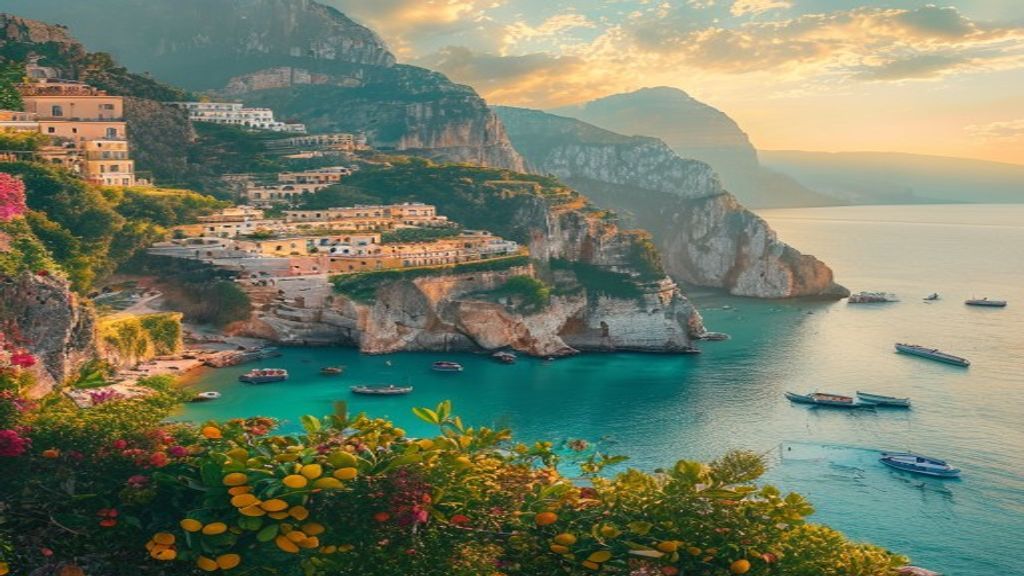
The towns appear in sequence like pearls: Positano first, its pastel houses cascading down the hillside in a tumble of terracotta and bougainvillea, still sleeping, its famous beach a stripe of dark pebbles catching the first glint of sunrise. Then Praiano, quieter, more honest. Then the town of Amalfi itself, its cathedral steps swept clean, its piazza belonging entirely to pigeons and an old man with an espresso.
The Lemon Groves
Climb away from the shore — up the stone staircases that thread between houses, up past laundry lines and potted geraniums and hand-painted ceramic signs — and you enter a different world. The lemon groves of Amalfi are shaded by overhead pergolas of chestnut poles and netting, and inside them the air changes entirely. It becomes cool, and green-lit, and thick with citrus oil. The lemons here are the size of softballs, thin-skinned and extraordinarily fragrant. The groves smell less like a fruit and more like a feeling — clean, bright, uncomplicated.
An elderly woman appears from between the rows with a basket and does not look at all surprised to find you there. She hands you a lemon without a word. You peel the skin and breathe through it and feel something release in your chest you had not known was clenched.
The Sea at Mid-Morning
By nine, the water below is no longer just blue. It has become every blue — turquoise over the shallow limestone shelves, then aquamarine, then a deep lapis where the bottom drops away. Small wooden boats rest at anchor, their hulls faded to beautiful imprecision: chalky greens, dusty reds, whites gone soft with salt.
Swimming here is an act of surrender. The water is cool and clear and tastes sharply of salt and mineral. You float on your back and look up at the cliffs, which rise three hundred meters above the sea in a vertical wall of grey limestone and green scrub, topped distantly by a village balanced on the edge like a dare. The scale of it — cliff to sea, ancient to immediate — makes something in the rational mind go quiet.
Lunch Without a Clock
There is a restaurant in Ravello, set on a terrace above the valley, where they serve pasta with local clams and a white wine so cold it fogs the glass in the midday heat. The view from this terrace is the kind that painters have been attempting and failing to fully capture for three centuries: terraced hillsides dropping away to a sea that shimmers and shifts and absolutely refuses to hold still for anyone.
You eat slowly. You pour more wine. A cat appears and regards you with profound indifference. Below, a church bell marks an hour you don’t bother to count.
This is the lesson the Amalfi Coast teaches, if you let it: not every moment needs to become something. Some moments are simply, perfectly, enough.