The Salt Flats at the End of the World
On Bolivia's Salar de Uyuni, the boundary between earth and sky dissolves completely — leaving only a white silence so vast it rewires something deep inside you.
The Salt Flats at the End of the World
The first thing that strikes you about the Salar de Uyuni is not the size — though the size is incomprehensible, twelve thousand square kilometers of crystallized silence — but the flatness. A flatness so absolute and so complete that your brain, accustomed to the small imperfections of the world, quietly refuses to accept it. You blink. You look again. The horizon is a ruler’s edge, drawn in a steady hand, dividing white from blue with no room for compromise.
Arrival at Dawn
We drove out onto the flats before sunrise, the 4x4 crunching across the salt crust in the dark. Without the sun, the Salar is colorless and disorienting — no shadows, no depth cues, no way to judge distance. Headlights dissolved into nothing twenty meters ahead. It felt less like driving and more like floating through a void, untethered from geography.
Then the first light came.
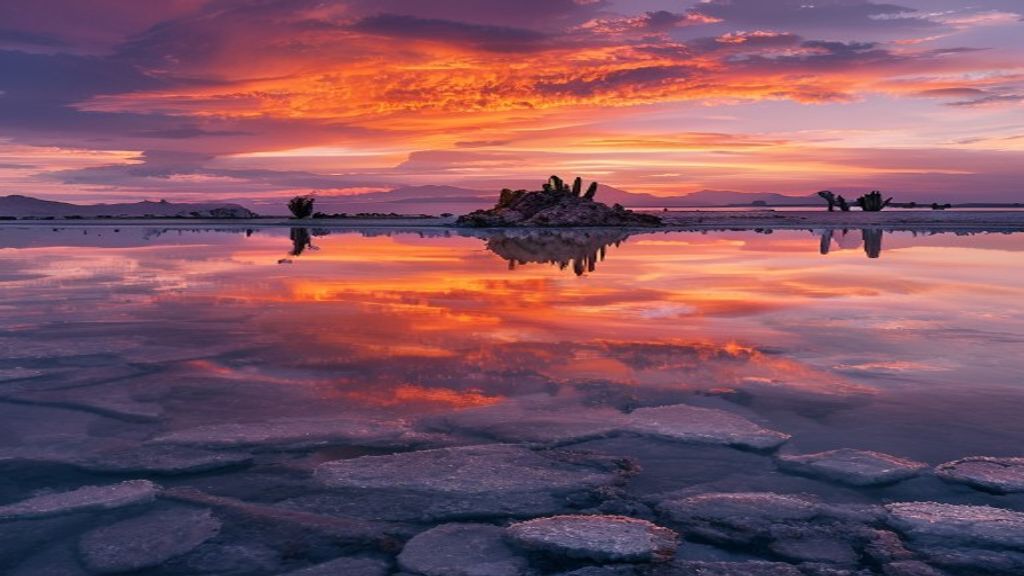
It arrived not as a sunrise but as a slow suffusion, a blush spreading from the eastern edge of the earth outward, unstoppable and tender. The salt took on color the way a blank canvas takes on paint — first pale pink, then peach, then a warm gold that seemed to burn from beneath the surface. The sky overhead stayed dark blue for a long time, unwilling to surrender the night, so for ten perfect minutes the salt was brighter than the sky above it. We were walking on the light source. We were standing on the sun.
The Mirror
The rains come to the Salar between December and March, laying a thin sheet of water across the salt — sometimes just a centimeter deep, sometimes less. In this condition, the flats become the largest natural mirror on Earth, and the effect is not a metaphor. It is not like a reflection. It is a reflection, perfect and total, so that the sky exists twice: once above and once below, and you walk between them.
Flamingos — impossibly pink against the white and blue — moved slowly through the shallow water, their reflections moving with them in perfect symmetry. They seemed less like birds and more like punctuation marks in an enormous sentence the landscape was composing.
The clouds moved across both skies simultaneously. You could watch a storm assembling itself in the water at your feet before you looked up to find it assembling itself again, in the same arrangement, overhead. Reality offered two copies of itself and expected you to choose.
The Island of Cacti
Incahuasi Island rises from the middle of the Salar like a fever dream: a rocky, rust-colored outcropping covered in towering cacti, some of them over ten meters tall. These cacti grow approximately one centimeter per year. The oldest ones here have been growing for over a thousand years. They were already ancient when the Spanish arrived on this continent. They will be ancient long after everything we’ve built has returned to salt.
We climbed to the top of the island and looked out. The white extended in every direction to the limit of vision and then beyond. No roads. No buildings. No trees. Just the hexagonal lattice of the salt crust, a geometric pattern that tiles the entire surface like the floor of a cathedral no god planned.
The altitude — 3,656 meters above sea level — made everything feel slightly unreal, slightly amplified. Colors were too vivid. Silences were too deep. Breathing required a conscious effort, a small negotiation with the thin air.
After Nightfall
We stayed past dark, past the point of wisdom, because the night on the Salar is a separate country from the day. Without light pollution for a hundred kilometers in any direction, the stars arrived in numbers that felt aggressive, too many, overwhelming — the Milky Way not as a smudge but as a structure, a dense and luminous architecture arching overhead.
And again, the reflection. The stars doubled in the standing water. We lay on the salt and looked up and could not be certain which direction was up.
Somewhere in that disorientation, between the two skies, in the white silence at the edge of the world, it became briefly impossible to remember what we had been worried about before we came here. The Salar has a way of doing that — of dissolving small concerns back into the salt, returning them to the earth, leaving you with nothing but the enormous, uncomplicated fact of being alive in a beautiful and bewildering world.