Salt and Silence: Crossing the Bolivian Altiplano
At the edge of the world's largest salt flat, the sky and earth dissolve into each other — a blinding, boundless white that rewires your sense of scale and reminds you how small, and how lucky, you are.
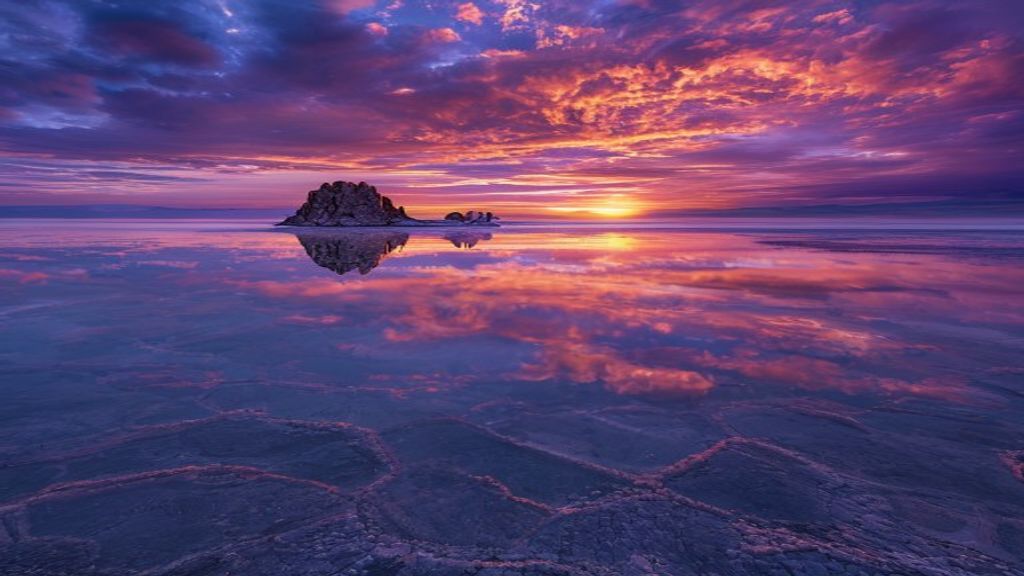
The Bolivian altiplano does not ease you in. There is no gentle introduction, no scenic approach road lined with signposts. One moment you are on cracked brown earth, and then — as if the land has drawn a single straight line and dared you to cross it — everything turns white.
Salar de Uyuni: 10,582 square kilometres of ancient salt, spread flat as a pane of glass at an altitude that makes your lungs work twice as hard for half the air.
Before the Sun Comes Up
You leave the village of Uyuni at 4:30 in the morning in a rattling Land Cruiser, wrapped in every layer you brought and two you borrowed. The cold here is not the cold of a winter city. It is elemental. It comes from the ground and the sky simultaneously, from the dark above and the salt below, and it presses against the windows like something with intent.
There are no roads on the salar. You drive by GPS and instinct, headlights cutting across a white nothing that extends to the horizon in every direction. You could be flying. You could be underwater. You could be in the seconds before a dream starts.
Then the eastern sky begins to bruise purple, then rose, then a thin line of fire orange along the rim of the world — and you stop the car and step out into the silence.
The Mirror World
The rains have come and gone recently, and the salar is wearing its legendary skin: a thin sheet of water, perhaps two centimetres deep, stretched across the salt crust like a lens placed over the earth. The sky — every cloud, every shade of dawn blue, every last star — is reflected perfectly in it.
You take a step and the water barely moves. You are walking on the sky. The horizon has vanished. There is no up, no down, only a sphere of light and cloud and colour that surrounds you completely, and you, at the centre of it, casting the only shadow in all directions.
This is the photograph that changes people. More than that — it is the feeling that changes people. The precise, physical sensation of being cosmically small and completely, inexplicably present.
The Island That Shouldn’t Exist
By mid-morning the mirror has evaporated, and the salar has returned to its dry white self — a surface so bright your sunglasses are not enough. You navigate toward Isla Incahuasi, a rocky outcrop rising from the salt like a hallucination. Its slopes are covered in ancient cacti, some of them ten metres tall, growing at the rate of one centimetre per year. The oldest ones have been here for a thousand years.
You climb to the highest point of the island and look out. The white extends to every horizon. There is no town, no road, no movement. Just the wind and the salt and the impossible sky overhead — the deepest, most saturated blue you have ever seen, because at 3,600 metres there is less atmosphere to dilute it.
The cacti are very still. The salt is very flat. The silence is so complete you can hear your own heartbeat.
The Drive Out Through Flamingo Country
In the late afternoon you leave the salar and push south toward the coloured lagoons — Laguna Colorada, its waters stained blood red by algae, its shores crowded with pink flamingos that stand in the crimson water as if they have always known they are beautiful. The landscape shifts from white to rust to ochre as the sun drops and the volcanic peaks cast long purple shadows across the plain.
You have been here one day. You feel as though you have travelled to another planet and quietly returned.
What the Salt Keeps
The altiplano does not flatter you. It offers no shade, no comfort, no scale you are equipped to process. It simply exists — vast, indifferent, and so violently beautiful that the only honest response is silence.
You carry the white with you when you leave. In quiet moments, sometimes, you still feel it underfoot — that thin cold mirror, the whole sky beneath your boots, and the impossible sense that for one morning on the roof of the world, you walked inside the light.