Salt & Light: Mornings on the Amalfi Coast
The Amalfi Coast at first light is a world of cliffs, lemons, and sea-wind — where villages cling to rock faces like barnacles and the Mediterranean gleams like hammered bronze. A sensory essay about slowness, beauty, and the particular joy of being somewhere impossible.
Salt & Light: Mornings on the Amalfi Coast
The alarm was set for 5:45 a.m., but the light woke me first.
It came through the shutters in thin gold blades, painting stripes across the whitewashed wall, and for a moment I had no idea where I was — only that the air smelled of salt and lemon blossom and warm stone, and that whatever was outside those shutters was something I needed to see immediately.
I threw them open onto the Tyrrhenian Sea, three hundred meters below, and lost my breath.
The Village Before It Wakes
Positano in the early morning belongs to no one and everyone. The tourists who flood the staircases by ten o’clock are still asleep in their villas. The piazza holds only a tabby cat and a man in a white apron stacking chairs outside a café, his radio murmuring something low and Italian into the salt air.
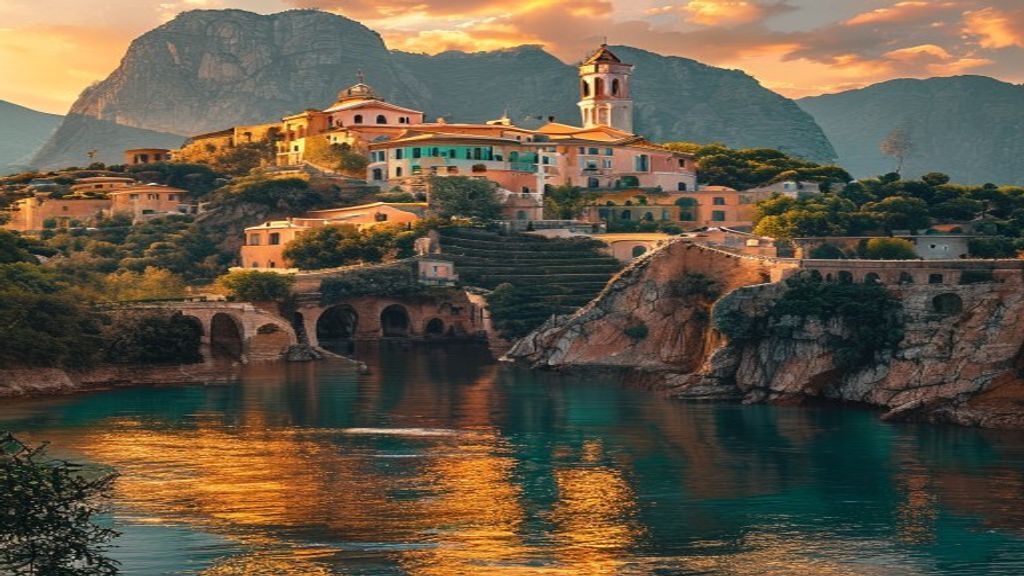
The village spills down the cliffside in layers: terracotta rooftops and bougainvillea-draped balconies, lemon groves terraced into near-vertical slopes, the dome of Santa Maria Assunta catching the earliest light and throwing it back as a blush of rose and gold. Below it all, the pebble beach is empty, the fishing boats pulled high above the tide line, their hulls faded to the gentle pastels of old paintings.
I walked down a thousand steps — it always feels like a thousand — through tunnels of jasmine and past walls painted in that specific shade of apricot that only exists on the Amalfi Coast. Every corner turned into a painting. Every shadow was violet.
The Sea at First Light
At the water’s edge, the Mediterranean was doing something extraordinary.
The sun, still low and hesitant, was skimming the surface at a shallow angle, turning the water from deep navy to liquid copper to blinding white gold in the space of a hundred meters. The sea was perfectly calm — that breathless, glassy calm that only happens in the hour after sunrise — and the cliffs of the Lattari mountains were reflected in it, inverted and wavering, so that the whole bay became a Rorschach of rock and sky.
The smell of it: brine and ozone and faintly, always, the lemon groves high on the terraces above. That combination — citrus and sea — is the scent of the Amalfi Coast, and it is intoxicating in the most literal sense. It makes you dizzy with a kind of low-grade joy.
I sat on a flat rock until the sun cleared the ridge entirely and the bay blazed to full noon-blue, and I thought: there are places that make beauty feel like something you owe them attention for.
The Road to Ravello
The SS163 — the coastal highway — is one of the great acts of human audacity. Carved into the cliff face in the 1850s, it clings to the rock like a ribbon of determination, doubling back on itself, diving into tunnels, erupting onto promontories with views that make your stomach drop.
I drove it mid-morning, windows down, in a rented Fiat that felt approximately the size of a shoebox. The road was barely wide enough for two cars to pass, and whenever a bus came the other direction, both vehicles performed a delicate, terrifying ballet of mirrors and prayer.
But the views. Between every blind corner and every hold-your-breath overtake, there was the sea — hammered bronze in the growing heat, stretching flat and infinite toward Africa. Villages appeared and vanished: Praiano, Conca dei Marini, Furore. A cluster of boats in a cove. A lemon grove hanging over a wall, the fruit heavy and bright as little suns.
Ravello: The Garden at the Edge of the World
High above the coast, Ravello feels genuinely detached from the ordinary world — which may be why Wagner composed here, and why Gore Vidal lived here for thirty years, and why standing in the gardens of Villa Cimbrone feels like standing at the edge of all perceivable reality.
The Belvedere of Infinity: a stone terrace at the garden’s far end, lined with marble busts gone green with age, looking out over a drop of three hundred meters straight to the glittering sea. The horizon is absolute. The air, at this height, has lost its saltiness and tastes of thyme and sun-warmed stone.
There was a cat sleeping on one of the balustrades, one paw hanging over the abyss, unconcerned. Below, the Amalfi Coast spread itself out in its impossible, extravagant beauty — the cliffs, the villages, the lemon terraces, the sea going on forever.
I took no photos. Some things resist being framed. Some things you just have to stand inside and let happen to you.