Salt and Gold: Sunrise on the Bolivian Salt Flats
At the edge of the world's largest mirror, the sky and earth become one at dawn — a blinding, beautiful confusion of pink, gold, and infinite white. A photo essay from the Salar de Uyuni.
Salt and Gold: Sunrise on the Bolivian Salt Flats
The alarm goes off at four in the morning and the temperature inside the jeep is below freezing. You don’t check your phone. You don’t speak. The driver — a man of very few words and very sure hands — steers across the flat darkness without headlights, navigating by something that isn’t a road. You can’t see anything outside the window except stars, more of them than you believed possible, pressed so close and so thick they seem to have weight.
And then the horizon begins to change.
The World Before Color
For a long moment, everything is the same shade: a deep, blue-grey that belongs to neither night nor morning. The Salar de Uyuni — 10,582 square kilometers of ancient salt lake in the southwest corner of Bolivia, the largest of its kind on Earth — absorbs this pre-dawn non-color and holds it. The surface, which will later become a mirror, is now a matte white plain that stretches so far in every direction that the curvature of the earth becomes something you feel in your chest rather than see with your eyes.
You step out of the jeep. The cold hits you immediately, a clean, brutal cold that comes from altitude — 3,656 meters — not from shadow. Your boots crunch on the hexagonal salt tiles beneath you, each one a perfect geometric tile, the residue of a prehistoric sea that dried ten thousand years ago. It crunches like packed snow but feels nothing like it. Harder. Older.
The silence is not empty. It has texture.
The Thin Pink Line
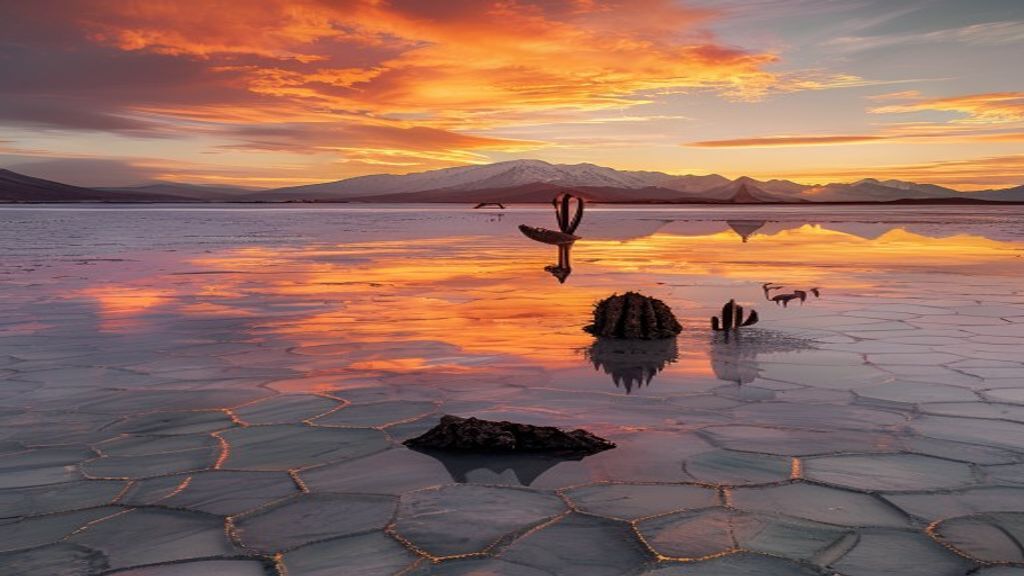
It begins as a single thread of pink along the eastern horizon, barely distinguishable from imagination. Then it thickens. The pink becomes amber becomes gold, and as the light changes the surface of the salt flats begins to respond — first a dull blush, then a shimmer, then, as the sun clears the distant volcanic peaks of the Cordillera Occidental, a full, breathtaking blaze.
After rain — and in the wet season, water sits in a thin layer across the flats — the reflection is total and disorienting. Sky above, sky below. The volcanoes in the distance appear to float. The mountains are unmoored. You are standing inside a world that has doubled itself, and the horizon line, that fundamental human anchor, has simply dissolved.
You look down at your feet and see the sun rising beneath them.
Islands in an Impossible Sea
Rising from the centre of the flats is Isla Incahuasi — Incahuasi Island — a rocky outcrop covered entirely in ancient cacti, some of them over a thousand years old, their arms raised in what looks, this morning, unmistakably like celebration. From a distance, the island appears to hover a centimeter above the salt, a trick of the light and the reflective water that surrounds it.
The cacti cast long shadows in the early light, deep purple fingers stretching east across the white. A pair of flamingos move through the shallow water near the island’s base — pink, improbably pink against all this white and gold — dipping their curved beaks into the brine in a slow, unhurried choreography.
They don’t notice you. They have, in all likelihood, never needed to.
The Hour the Light Turns
Around eight in the morning, something shifts. The gold in the light cools. The mirror surface begins to show its salt beneath the water — hexagons within hexagons, a geometry so precise it seems engineered. The volcanoes reappear on the horizon, their snow-capped summits now catching the full light: Tunupa to the north, patient and enormous, trailing a long white cloud from its summit like a flag.
The driver has made coffee on a small gas burner beside the jeep. He hands you a cup without ceremony. It is strong and slightly too sweet and the best thing you have ever tasted.
What Emptiness Teaches
There are places in the world that feel like endings — the last page of something immense and slow. The Salar de Uyuni is one of them. Not because it is bleak — it is the opposite of bleak — but because it offers a silence and a scale that most human lives don’t prepare you for.
Out here, at the end of a long dirt road in the Bolivian altiplano, with salt on your boots and coffee in your hand and the entire sky laid flat at your feet, you are reminded that the Earth is very old and very large and was here long before the alarm clocks and the itineraries.
And when the light turns just so — when the pink fades back through gold into the clear, high-altitude blue of a Bolivian morning — you understand, without words, why people come so far to stand in a place that contains almost nothing.
Almost nothing turns out to be exactly enough.