Salt & Gold: Morocco's Desert Edge at Sunset
At the border where the Sahara begins, the light does not fade — it transforms. A photo essay from the dunes of Merzouga, where the desert teaches you to slow down and listen.
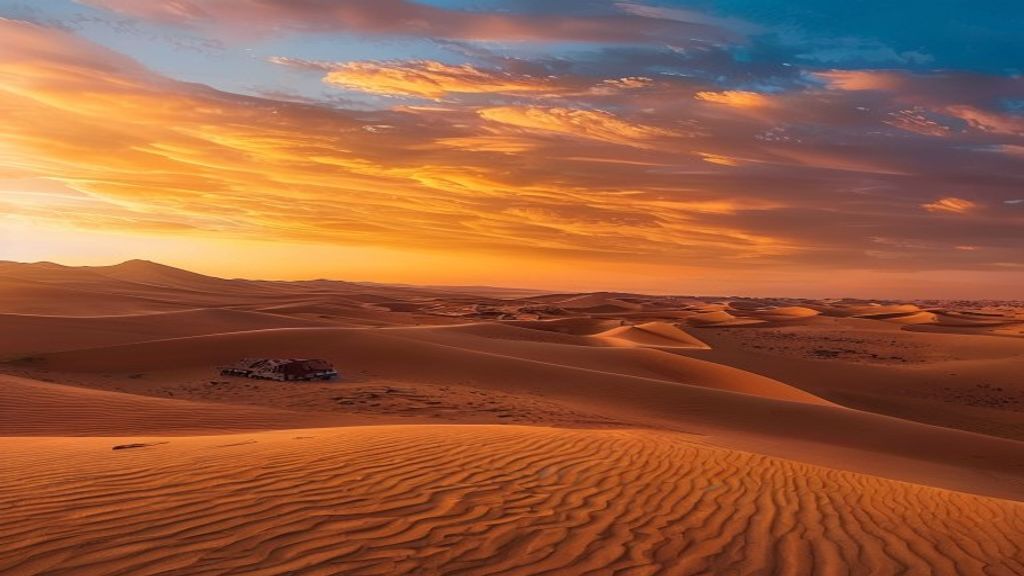
The Sahara does not announce itself. There are no signs, no gates, no clear border where the world of roads and rooftops ends and the great silence begins. It simply arrives — one moment you are driving through scrub and rock, and then the dunes are there, impossibly tall, impossibly golden, rising from the flat earth like something dreamed.
This is Merzouga, in southeastern Morocco, at the end of a long day and at the beginning of something else entirely.
The Hour Before Gold
In the hour before sunset, the Erg Chebbi dunes are the color of pale cream. The light is still high and clinical, casting sharp shadows in every ripple of sand. From a distance, the dunes look smooth, almost soft — like bolts of silk folded by a careless hand. Up close, every surface is textured with the memory of wind: fine parallel ridges, sharp crests, tiny avalanches of grain that hiss as they tumble.
The air smells of dust and something mineral, clean in the way that only vast empty spaces can be clean. A desert wind moves through constantly, warm as breath, carrying with it a faint sound that is not quite music and not quite silence — a kind of tonal hum the dunes make when the air moves across them.
You climb. The sand gives way under every step, so that each stride upward costs you half a stride in slide. By the time you crest the first great ridge, your calves ache and your lungs are full of clean, hot air. Below you, the camp’s low tents are the size of beetles.
The Light Breaks Open
Then the sun lowers, and the desert is remade.
It begins at the crests of the highest dunes, which catch the first angled rays and turn a deep, saturated orange — the color of saffron, of old bronze, of embers. The color moves down the dune face slowly, like a tide, and as it moves, the shadows on the opposite faces deepen from grey to violet to near-black.
The Sahara at golden hour is a study in contrast so severe it looks composited, assembled by an artist who was never taught restraint. The ridgelines glow. The valleys plunge into indigo shadow. The sky above transitions from cobalt to copper to a thin burning band of rose along the far horizon, and in all of that sky there is not a single cloud, not a single interruption — just pure, saturating color from edge to edge.
You sit at the top of your dune and do not take a single photograph for ten minutes. Some sights require an audience, not a recording.
The Silence After Dark
The stars in the Sahara are a cliché — every travel writer who has slept beneath them has reached for superlatives and found them wanting. But here is an honest attempt: the Milky Way over Merzouga is not a band of light. It is a texture. It is dimensional, layered, thick with depth in a way that forces your brain to recalibrate what it thought a sky was supposed to look like.
You lie on a wool blanket outside your tent and let your eyes adjust. First the bright anchor stars. Then the secondary constellations. Then the vast smear of the galactic core, which slowly reveals itself like a Polaroid developing in reverse — the longer you look, the more appears.
There are sounds. A camel shifting its weight somewhere in the dark, its bell ringing once and then going quiet. The almost inaudible sigh of sand cooling and contracting. The wind, which never fully stops.
What You Carry Out
Leaving the desert the next morning, before the heat becomes serious, you retrace your steps across the crust of a dry salt flat that glints like shattered glass in the early sun. The mountains of the High Atlas are a blue smear on the horizon ahead. Behind you, the dunes catch the first light of a new day and begin their slow daily transformation again — cream to gold, gold to fire, fire to the long blue shadows of dusk.
The Sahara will not remember you were here. The wind will erase your footprints by noon.
But you will remember the weight of that silence. The smell of warm sand and mineral air. The specific color of a dune crest at the precise moment the sun lets go of the day.
Some places do not decorate your life. They resize it.