Saharan Midnight — The Stars Over Merzouga
In the Moroccan Sahara, the dunes of Merzouga rise and fall like a sleeping giant, and when darkness falls, the sky above becomes the most overwhelming thing you have ever witnessed.
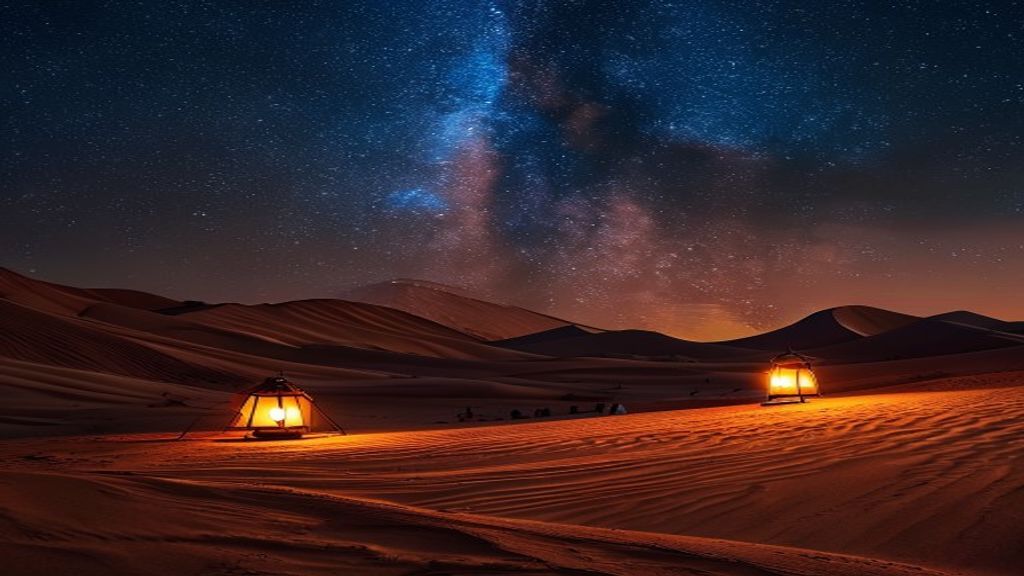
Saharan Midnight — The Stars Over Merzouga
The Sahara is the oldest silence in the world. Not the silence of a room after an argument, or of a forest at winter — but a silence so complete, so ancient, that it has a texture. You feel it against your skin. You taste it, faintly mineral, on the back of your tongue. And at midnight, when the last ember of the campfire has collapsed to orange ash and the desert cold presses in from every direction, it becomes the loudest thing you have ever not heard.
This is Merzouga. This is the edge of everything.
Arriving at the Erg Chebbi
The road from Rissani follows the hammada — the flat, black-stone plain that is the true face of the Sahara, not the romantic sea of dunes, but the stripped and ancient rock beneath. For hours, the landscape is relentless in its emptiness. Occasional desert scrub. A stopped vehicle. A distant smudge of a village that vanishes before you’re sure you saw it.
And then, impossibly, the dunes appear. The Erg Chebbi rises from the flat earth without warning or apology — dunes that reach 160 metres at their peak, their knife-edge ridges sculpted new each day by winds that do not negotiate. In the late afternoon light, they are the colour of apricots, of saffron, of the inside of a flame. Their shadows are violet-blue and perfectly precise. This is not sand as you know it. This is topography. This is drama.
You leave your shoes at the base of the first dune and begin to climb.
The Climb to the Ridge
Sand has a sound when you walk through it at dusk — a soft, whispering drag that follows each step like an echo of itself. The surface is warm near the top where the sun held longest, cooler as your feet sink to the layers beneath. Each step forward gains half a step in the giving slope.
At the ridge, the wind arrives without warning. It has crossed thousands of kilometres of open desert to find you here. It pulls at your clothing. It lifts a fine skin of sand from the crest of the dune and carries it away in luminous curtains, trailing gold in the dying light.
Below, to the west, the hammada stretches back toward Morocco proper, already dark. To the east, Algeria. Before you, in every direction that matters, dune after dune recedes into the dusk, each one slightly paler than the last, until the furthest are the colour of smoke and indistinguishable from sky.
You sit. You do not speak. There is nothing to add.
When the Stars Begin
Darkness comes fast in the desert. There is no gradual dimming — the Sahara switches modes with the efficiency of an ancient, indifferent system. One moment the western horizon is a band of copper and deep rose; the next, that band has narrowed to a thread; the next, it is gone.
And then the stars.
If you have only ever seen stars from a city, or even from a rural European countryside, you are not prepared. You think you know what a sky full of stars looks like. You do not. Here, with zero light pollution and air so dry and clear it functions almost as a lens, the Milky Way is not a suggestion — it is a structure. A river of light so dense and three-dimensional that it creates the vertiginous sensation of depth, of falling upward into it.
You count the shooting stars. You stop counting at eleven. The silence around you has become immense, a cathedral without walls, without ceiling, every surface made of darkness and light simultaneously.
Before the Dawn
Sometime in the deep hours before sunrise, the cold becomes serious. The temperature has dropped twenty degrees since sunset. You pull your blanket tight and lie back on the still-warm slope of the dune, face turned skyward.
The stars wheel slowly overhead, as they have over this desert for a hundred thousand years of human experience. Nomads navigated by them. Caravans followed their logic across thousands of miles of uncertain terrain. People were born and died beneath this same canopy of light, in this same silence, feeling — you are certain — exactly this same vertigo of smallness and wonder.
The Sahara does not make you feel insignificant. It makes you feel exactly the right size. Part of something immeasurable, but connected to it entirely. A single grain of sand on the highest ridge of the largest dune, in the most luminous darkness you will ever know.