Sahara Nights: The Desert After the Sun Lets Go
Once the brutal Saharan sun dips below the dunes, an entirely different world wakes — cold, vast, and scattered with more stars than you believed the sky could hold. A journey into the silence at the edge of everything.
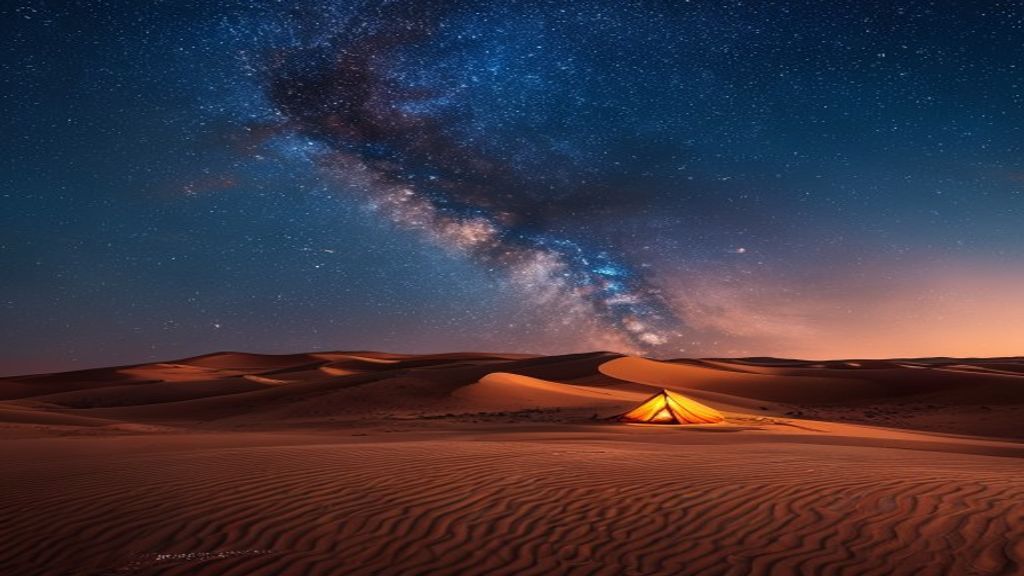
The Sahara does not ease you in gently. It takes you by the collar the moment you step off the last tarmac road in the Drâa Valley and reminds you, plainly and without sentiment, that you are very small, very temporary, and completely welcome.
This is not a comfortable place. It is, however, an astonishing one.
The Hour Everything Burns
Arriving at Erg Chebbi in the late afternoon is a lesson in elemental violence. The sun — low now, thank god — turns the dunes into something between copper and fire, and the shadows they cast are so sharp and deep they look painted. The sand is not beige, not tan: it is amber, rose, arterial red, all at once, shifting with every passing cloud.
You climb the nearest dune barefoot. The surface layer is warm silk; six inches down, it is already cool, compacted, firm. With each step you sink and slide, and the dune accepts this patiently, as if it has watched a million such clumsy ascents and forgiven all of them.
From the crest, the Erg stretches in every direction to the horizon — wave upon wave of sculpted sand, interrupted by nothing. Not a road. Not a wire. Not a sound except wind.
When the Colour Drains Away
Sunset in the Sahara is not a slow, photogenic fade. It is a rapid evacuation of warmth. One moment the sky is tangerine and violet; the next it is a deep, bruised indigo, and then, almost instantly, it is the blackest black you have seen outside a cave.
The temperature follows the light down. You pull on every layer you brought, and it is still not quite enough, and that’s fine — the cold is part of the instruction. A Berber guide named Hassan who has been leading caravans since before you were born hands you a glass of mint tea without a word. It is scalding and sweet and possibly the best thing you have ever tasted.
The Stars Do Their Work
And then the stars arrive.
Not a few of them. Not the polite scatter visible from a European hillside or a rural American highway. All of them. The Milky Way does not arc across the sky here — it fills it, a river of cold light so dense and wide it casts a faint shadow on the sand below.
You lie on your back on the cooling dune and feel the vertigo of it: the sense that the sky is not above you but around you, that there is no up or down, that the sand is all that keeps you from falling endlessly outward into that luminous dark. It is terrifying and euphoric in equal measure, and you stay there for a very long time.
The Silence Between Sounds
The desert is not, it turns out, silent. It is full of sounds so subtle they require the absence of everything else to be heard.
There is the whisper of sand grains migrating in the night wind — a sound like distant radio static, like the universe tuning itself. There is the occasional low moan of a dune settling, which the Tuareg call the chant des dunes: the song of the dunes. Scientists will tell you it is caused by compressed sand layers shifting. Lying in your tent at midnight, looking up through the mesh ceiling at the stars, you are not particularly interested in the scientific explanation.
There are distant bells: the neck bells of camels tethered somewhere in the dark, a sound old as trade itself.
What Remains When Everything Is Stripped Away
On the second morning, before dawn, you climb the same dune again. The sky ahead is still black; behind you, over Morocco, it is beginning to turn the faintest marine blue. The sand is cold and perfect and unmarked. You stand at the top and watch the light return to the world.
It comes slowly this time — a long wash of rose along the eastern edge, then gold, then finally the sun itself, small and fierce and merciful, and the dunes catch fire once more.
The Sahara, you understand now, is not empty. It is the opposite of empty. It is the place where the world has been most thoroughly, carefully filled — with light and silence and time — and everything unnecessary removed.
You stand there until your shadow is long behind you. Then you turn, and begin the slow, sliding walk back down.