Sahara at Sunrise: The Hour the Desert Remembers Itself
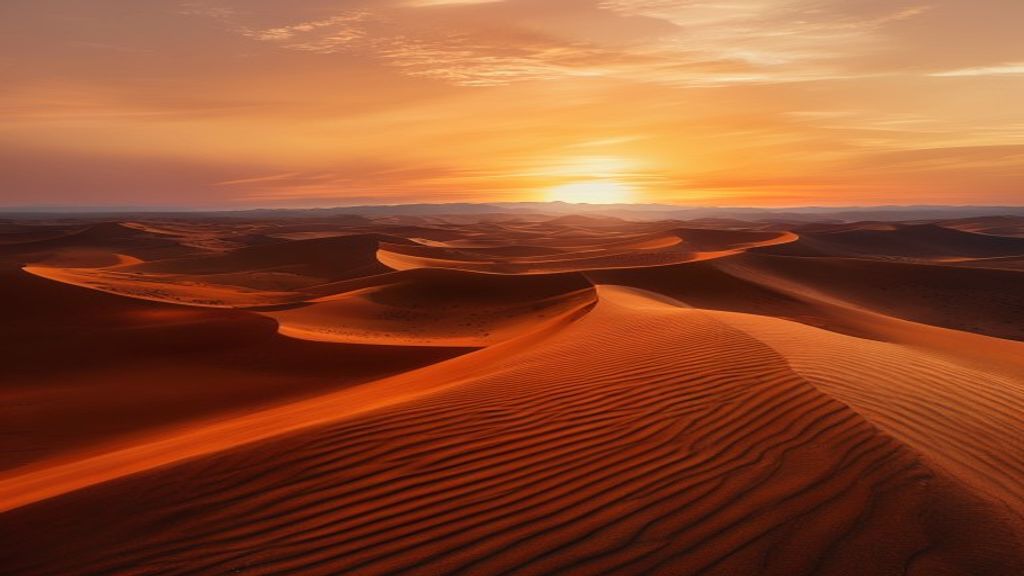
For a few minutes each morning, just as the sun clears the dune crests of the Sahara, the entire desert turns the color of ember and apricot — and the silence becomes something you can almost hold. This is the hour the desert remembers itself.
Sahara at Sunrise: The Hour the Desert Remembers Itself
You wake before the alarm. Something shifts in the quality of the darkness — a loosening, a held breath beginning to release — and your body understands before your mind does. The desert is about to do the thing it does.
You pull on every layer you brought and step outside the bivouac tent into cold that surprises you every time, no matter how many mornings you’ve done this. The Sahara’s nighttime temperatures are a joke it tells at your expense, after all those hours of brutal afternoon sun. You forgive it immediately.
Before the Light: The Blue Hour
In the minutes before sunrise, the Erg Chebbi dunes near Merzouga exist in a color that has no good name in English. Not blue, not grey, not purple — something between all three that the French call bleu de nuit and that feels, standing inside it, like being submerged in cool water. The dune crests are crisp black lines drawn against a sky that is only just beginning to dilute.
Nothing moves. There is no wind yet — the wind comes later, with the heat. The silence is not the silence of an empty room. It is the silence of a full one, of something immense holding its breath.
Your footprints from yesterday have been erased overnight. The sand has healed itself, seamless and unwritten, and you understand suddenly why people have always come to deserts to think about God, or time, or whatever it is they came to think about.
The Crest of the First Dune
Climbing a dune in the dark is slow work. The sand gives way with each step, so that you gain perhaps two-thirds of what you spend, and your lungs work in the cold air. But the ridge arrives, and you sit on it, and the eastern horizon begins to do something extraordinary.
The sky lightens in bands. First a deep plum, then a streak of tangerine so precise it looks drawn with a ruler, then a bloom of rose gold that spreads upward as if the horizon were leaking warmth. The stars do not go out so much as they recede — backing away politely to make room for something brighter.
And then the sun itself: not a sudden event but a slow, enormous intention. It clears the far dune crest and the entire desert changes color in seconds.
The sand, which was blue-grey moments ago, becomes apricot, then amber, then a deep burnished copper that makes every grain look lit from within. The shadows cast by the rippled surface — those delicate wind-scribed ridges no taller than a finger — stretch for meters, turning the flat expanse into something topographic, dramatic, endlessly detailed.
You have seen photographs of this. The photographs do not prepare you.
Wind, Sand, and the Geometry of Impermanence
By seven in the morning, the first breath of wind arrives from the northeast — faint, exploratory — and the summit of the dune you’re sitting on begins, grain by grain, to migrate. You watch sand lift from the crest in thin horizontal veils, catching the low light so that each brief cloud of it sparks like ground glass.
In an hour, this dune will look different. In a week, it will have moved. The Sahara is not a landscape in any ordinary sense; it is a process. A slow, enormous, indifferent reshuffling that has been going on for thousands of years and will continue for thousands more, long after every footprint — yours, mine, the camel caravan’s — has been smoothed away.
There is something clarifying about impermanence at this scale. Your anxieties, imported from cities, feel provincial here. The desert has no opinion of them.
Tea in the Silence
Back at the bivouac, your guide has a fire going and a blackened kettle on it, and the tea he pours — Moroccan mint, very sweet, very hot — tastes like the best thing you have ever consumed, because you have walked through cold and dark and wonder to arrive at it.
The sun is fully up now. The dunes have settled into their daytime palette: pale gold, bone white, the shadows retreating as the light flattens. It will be mercilessly hot in three hours.
But right now, cradling the small glass in both hands, watching the steam rise in the windless morning air, you are exactly in the right place at the right time — a feeling rare enough to recognize when it comes, and wise enough, for once, to simply let it be.