Sahara at Sunrise: The Desert Before the World Wakes
In the hour before the Sahara sun climbs above the dunes, the world is all copper and silence — a landscape so vast and so ancient it makes the concept of time feel faintly absurd.
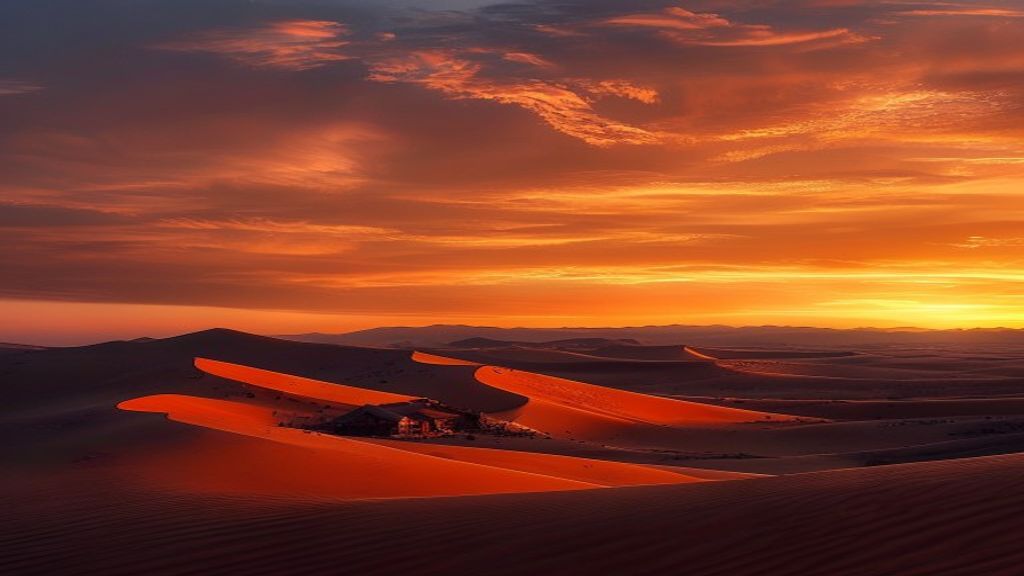
The Sahara does not ease you in. There is no gradual transition, no polite blurring of edges. One moment you are in the scrubby flatlands south of Merzouga, the track rough and ordinary beneath the wheels; the next, the dunes are simply there — enormous, impossible, rising from the earth like frozen waves in a burnt-orange sea. The shock of their scale never softens, no matter how many times you have been told what to expect.
You are woken at 4:30 a.m. The guide says one word: yalla. Let’s go.
The Climb in Darkness
Climbing a dune before sunrise is a private negotiation between your body and the sand. For every two steps forward, the slope swallows one back. The grains are cool — almost cold — a fact that astonishes first-time visitors who have come armored against imagined inferno. The Sahara night is a refrigerator. You are grateful for the fleece you almost left behind.
At the crest, your lungs are burning. But then you stop, and you look, and the burning ceases to matter.
Below you, to the east, the horizon is beginning to separate itself from the sky. A hairline of pale gold runs along the edge of the world. Above it, an impossible gradient: gold to amber to coral to a deep, star-pricked indigo that still holds the night in its upper reaches. The dunes beneath that sky are not yet orange — they are mauve and rose and the colour of something that has no name in English.
The Moment the Light Moves
The sun does not rise so much as ignite. There is a single instant — you will feel it before you see it — when the light tips over the horizon and the entire desert reorganises itself. Shadows that ran west are swallowed. New shadows, razor-sharp and ink-dark, shoot east from every ripple in the sand. The dunes turn copper, then bronze, then a vivid, furnace orange that seems to generate its own heat.
A wind moves across the face of the dune and reshapes it, grain by grain, in real time. The Sahara is never still. It is always, slowly, migrating — always erasing the evidence of the night before and writing new contours by morning. You are standing on something that will not exist, in precisely this form, by tomorrow.
Tea in the Tent
Back at the camp, the guide has made tea. This is non-negotiable. The ritual of Moroccan tea in the desert is its own ceremony: the pot raised high, the stream of amber liquid arcing into small glass cups ringed in gold, the four spoonfuls of sugar that transform it into something between a beverage and a dessert. You sit on a woven blanket outside the tent and drink it in three sips, as tradition requires.
The camp is simple: a handful of Berber tents, their canvas walls breathing in the morning breeze, hand-stitched rugs on the sand floors, the smell of woodsmoke and mint. A camel somewhere out of sight makes a sound of profound complaint. The sky is now a hard, clean blue — the theatrical blue of a place with no humidity, no haze, nothing between you and the outer atmosphere except a column of breathtakingly clear air.
What the Desert Keeps
The Sahara is 7,000 years older than the concept of a border. Entire civilisations have navigated it, sheltered within it, been swallowed by it. Standing on a dune at sunrise, watching the light rebuild the landscape from scratch in a matter of minutes, you feel that history not as a thought but as a physical sensation — a low, resonant hum beneath the silence.
The desert asks nothing of you. It does not perform. It is simply, staggeringly, itself — and in return for your presence, it offers something most of modern life withholds: the profound relief of feeling genuinely small.