The Sahara at Nightfall: Where the World Runs Out of Edge
As the last light drains from the Sahara's dunes, the desert doesn't go dark — it ignites, burning orange and violet before surrendering to a sky so full of stars it feels like a second horizon.
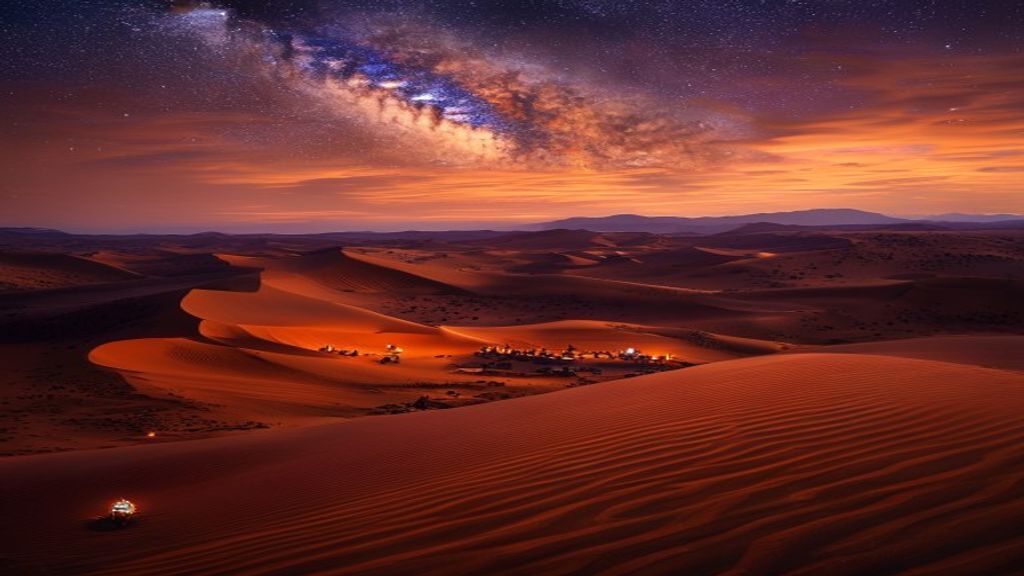
The desert teaches you one thing before it teaches you anything else: you are very, very small.
Not cruelly. Almost tenderly. Like it wants you to know, so you can relax.
Arrival: The Last Road
The road from Merzouga ends without ceremony. One moment there is tarmac, cracked and heat-bleached, and then there is simply sand — fine, rust-colored, absolute. The Toyota that brought you here idles for a moment at the edge, as if deciding, and then the driver cuts the engine and nods at the horizon. That’s all the instruction there is.
You step out and the heat lands on you like a hand on your shoulder. It is 4:30 in the afternoon. The sun is still high and enormous, a white disc without mercy, and the dunes — the erg, the great rolling sea of sand — stretch south and east and west until they become sky.
The sand is soft in a way that surprises you. Not gritty. Almost silken. It gives beneath your feet with each step, and the effort of climbing the first dune is real: burning calves, lungs working, hands reaching forward to grip the ridge. But at the top, you stop. You forget everything you were thinking about before you got here. This is what you came for.
The Golden Hour That Lasts Forever
The light changes in the Sahara the way music changes key — you notice it only after it’s already happened.
At 6 p.m., the dunes are gold. The shadow lines are crisp and clean, dividing each ridge into burning light and cool blue shade with the precision of a calligrapher’s stroke. The crests of the dunes ripple with wind-patterns — delicate, parallel, immaculate — as if someone has raked them with infinite patience.
At 6:30, the gold deepens to amber. Then to copper. The shadows lengthen until they are more dune than the dunes themselves. The sky above begins its slow migration: blue to turquoise, turquoise to the faintest blush of rose along the western edge.
At 7:00, something happens that no photograph has ever fully captured. The dunes turn violet. Not metaphorically — truly, deeply violet, as if the sand has absorbed all the color the sky is releasing and is giving it back changed. The world goes quiet in a way that has weight to it. Even the wind stops. You sit very still, because moving feels like interrupting something.
The Fire, the Tea, the Stars
The camp appears like something from a half-remembered story — low Berber tents, goat-hair dark, their entrance flaps glowing orange from within. A fire already burning in the sand outside. Mint tea poured from a height, the stream of amber liquid catching the firelight as it arcs into small, handleless glasses.
You drink it scalding and sweet. The guide — a man who has lived near this desert his whole life and still watches the dunes with the expression of someone who finds them remarkable — tells you that the Tuareg say the desert has moods. That it looks different on the same day depending on which way your own mind is turned.
You believe him.
And then the stars come.
This is not hyperbole: the sky above the Sahara at night is incomprehensible. There is no light pollution for hundreds of kilometers in any direction. The Milky Way doesn’t arc across the sky — it fills it, edge to edge, a dense river of light so bright it casts a faint shadow. You lie back in the still-warm sand and look up and feel the vertigo of it: not up into the sky, but out into space, hanging from the surface of a planet in the dark.
Somewhere far off, a fennec fox makes a small sound and is quiet again.
Before the Sun Returns
You wake before dawn because the cold wakes you — a desert cold that is absolute and clarifying, that makes the air taste like metal and silence. You climb the same dune from yesterday, stumbling a little in the dark, and wait.
The eastern horizon turns silver. Then pearl. Then the thinnest line of gold appears along the base of the sky and the dunes — invisible seconds ago — slowly materialize from the dark, emerging from nothing the way a photograph develops in a tray of chemicals.
The world returns. The desert is here again.
It was always here. It was just waiting for the light to prove it.