Sahara at First Light: The Silence Before the Sun
The Sahara does not ease you into itself — it strips everything away until only light and silence remain. A photo essay from the edge of the world's greatest desert, written in the hour before dawn.
Sahara at First Light: The Silence Before the Sun
You wake at four in the morning to a cold you did not expect. The Sahara, everyone tells you before you go, is hot. What they don’t mention is the desert’s second nature: its absolute, bone-deep cold in the hour before the sun rises, the way heat is just a rumor the stars are keeping to themselves.
You pull on every layer you brought and step outside the canvas tent into a darkness so complete it has texture.
Then your eyes adjust, and the sky opens.
I. The Stars Before the Dawn
The Milky Way over the Erg Chebbi dunes is not a sight so much as a reckoning. It sprawls across the entire vault of the sky in a dense, luminous river — not the shy smear you glimpse from city outskirts, but something overwhelming, structural, ancient. The dunes beneath it are lit only by starlight, their ridgelines traced in faint silver against absolute black.
There is no wind. The silence is so total it becomes a presence of its own — a vast, attending stillness that feels conscious, almost watchful. You become very aware of your own breathing.
Somewhere beyond the dune ridge, a camel exhales.
II. The Colour That Has No Name
At five-fifteen, the eastern horizon begins its work. It does not announce itself — it simply begins to alter, a deepening of purple at the edge of the world that bleeds upward by degrees, pulling indigo and then a grey so pale it is almost white. The stars above it dim one by one, as if being recalled.
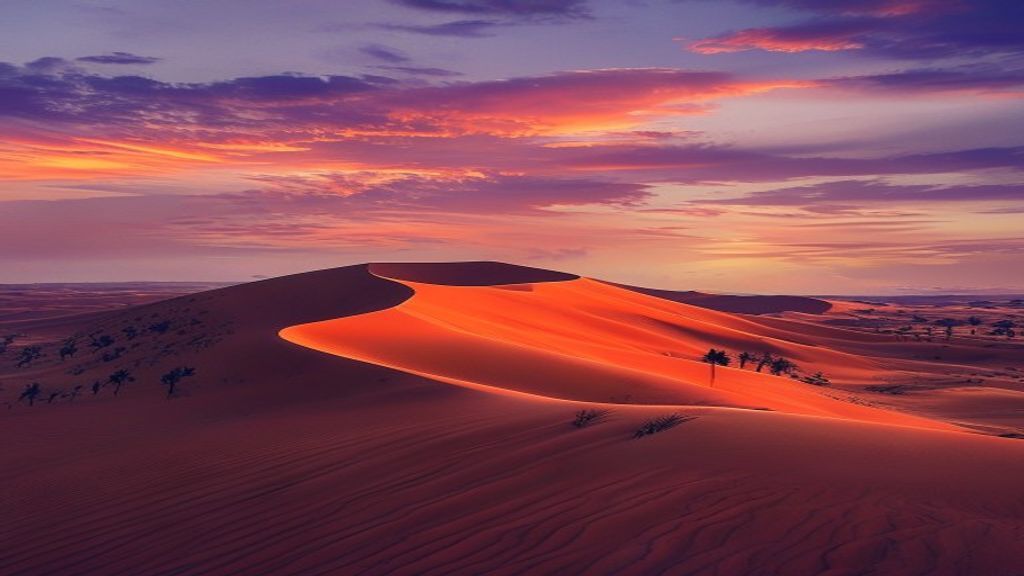
Then, at the precise moment when the horizon turns from purple to rose — a colour that exists nowhere else in nature with such clean, saturated certainty — the dunes respond. Their west-facing slopes remain in total shadow, absolute, flat black. Their eastern faces ignite in a warm coral-gold that travels down their curves like liquid.
The line between light and shadow on those dunes is the sharpest line in the world. You photograph it seventeen times and know, even as you shoot, that none of them will be right.
III. The Dunes at Sunrise
Climbing a dune at dawn is an act of patience and faith. For every two steps forward, the fine sand slides back one. Your breath comes harder than expected at altitude. The ridge, when you finally reach it, is knife-thin — you can stand with one foot on either slope and see two different worlds: the dark valley to the west, still in night; the blazing orange plain to the east, already in full sun.
The sand at the ridge is so fine it has the texture of powdered silk. Wind — just a breath of it — lifts a translucent veil of grains along the crest and carries it sideways in a slow, curling scroll before it falls again.
You sit at the top for a long time, watching the shadow line retreat across the dunes below, the desert filling up with light like a tide coming in.
IV. The Oasis Town at Eight O’Clock
By the time you descend and walk back through the edge of Merzouga, the town is waking. Smoke rises from a bakery; the smell of woodfire and cumin drifts through a blue-painted archway. Terracotta walls glow warm sienna in the full morning sun. A row of date palms casts long precise shadows onto a clay-red track.
A brass teapot sits on a low wall beside a mint plant in a clay pot. Everything is the colour of the earth it grew from.
You sit at a plastic table outside a café and drink three small glasses of mint tea poured from a great height, the way it is done here — the pour aerating the tea, cooling it just enough, raising a crown of foam that dissipates before you drink. Each glass is sweeter than the last.
V. What the Desert Takes and Keeps
There is a particular quality of mind that the desert produces — a quietude that is not emptiness but its opposite. The Sahara has a way of removing the noise between your thoughts until only the signal remains.
In the days after leaving, back in cities humming with urgency and light, you will find yourself pausing in the middle of ordinary moments — a traffic light, a crowded elevator — and hearing it again: that silence between the stars and the sand.
The desert gives it to you and then lets you carry it home, folded small, in the pocket of everything you do.
You will not, entirely, be the same person who arrived.