Sahara at First Light: The Desert Wakes
Before the sun crests the dunes of the Sahara, the desert holds its breath in a silence so complete it feels geological. A dawn journey across the world's greatest sea of sand, where the light rewrites everything.
The alarm doesn’t go off, because there is no alarm. You wake because the cold woke you — a cold so sincere and surprising in a place you associate with heat that for a moment you don’t know where you are. Then: the canvas of the tent above you, the sound of absolutely nothing, and the memory arrives all at once.
The Sahara. You are in the Sahara. And it is not yet light.
4 a.m.: The Temperature of Stars
The Erg Chebbi dunes of southeastern Morocco rise to nearly 150 meters — great frozen waves of ochre and amber that look, from the right angle and the right light, like the surface of another planet. But at four in the morning, they don’t look like anything. They are only presences: dark masses that occlude the stars at the horizon, constellations cut off mid-sentence.
The stars themselves are the first revelation. Without a town within fifty kilometers, without a single competing photon, the Milky Way materializes not as the faint suggestion you’re used to from rooftops or beaches, but as a physical thing — a river of cold fire arching overhead with such density and depth that looking at it induces something close to vertigo. You feel the planet’s rotation. You feel, specifically, that you are on a ball of rock spinning through an incomprehensible darkness, held to its surface by the thinnest of agreements.
The sand is cold beneath your boots. It squeaks, almost, with each step — a fine-grained sound you won’t forget.
The Climb Before the Sun
The dune guide moves without a headlamp, reading the ridgelines by starlight and memory. You follow in single file, the sand giving way slightly with each step, forcing you to climb with your whole body — arms out for balance, lungs working in the dry, cold air. The effort warms you. Your breath mists briefly and disappears.
The dune’s ridge is knife-sharp, a perfect curve that runs for hundreds of meters in either direction. You sit on it and face east. To your left, the knife-edge falls away into a bowl of shadow. To your right, the same. You are balanced on the spine of something vast.
The horizon, east, begins to change. It doesn’t brighten so much as remember — a reluctant, incremental recall of color, moving from black to the deepest possible blue, then violet, then a strip of amber so thin it seems theoretical. The stars directly overhead continue burning through the process, indifferent. They were here before the sand. They’ll be here after.
The Moment the Color Comes
Nothing prepares you for what the Sahara does when the first direct sunlight arrives.
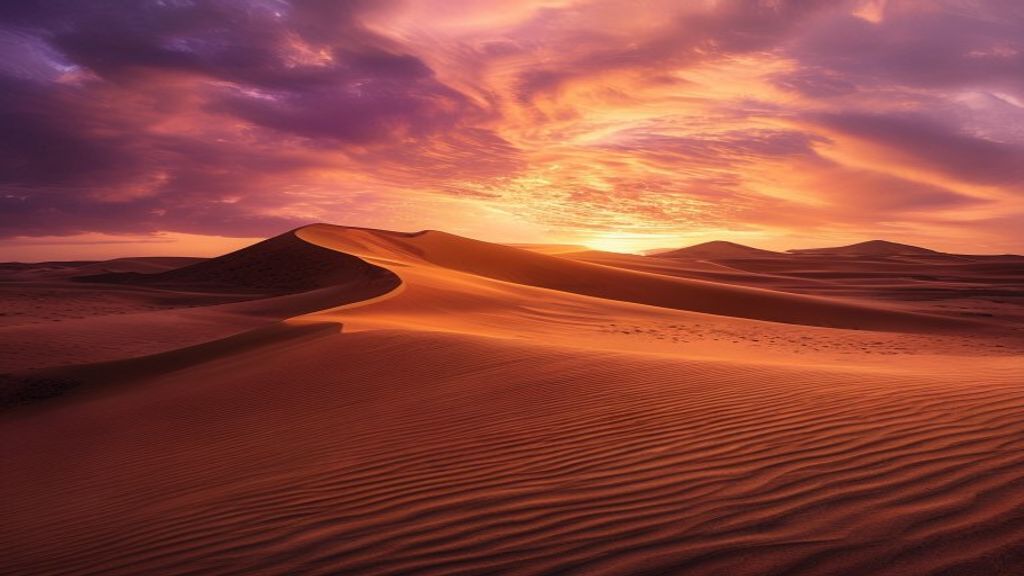
In the space of perhaps three minutes, the dunes transform. The flat pre-dawn grey — which had made the landscape feel like a graphite drawing — erupts into color. The sand nearest the sun becomes the orange of living embers. The shadowed flanks of the dunes deepen to a cool purple that has no name in any paint catalogue. The ripples left by last night’s wind — each one a tiny ridge, casting its own tiny shadow — create a texture so fine and intricate it looks woven.
The light moves. That is the thing that photographs cannot capture: the light is not static. It sweeps across the dune field like a hand drawing back a cloth, revealing warmth beneath. Each second changes the composition. Each second is better than the last, and then suddenly — perhaps ten minutes after sunrise — it plateaus, and the magic settles into something merely magnificent.
The Desert in Full Sun: Heat and Silence
By nine in the morning, the cold is a memory so complete you doubt it. The temperature has climbed twenty degrees. The dunes that were intimate and shadowed in dawn light are now hard-edged and enormous, the sky above them a saturated blue that seems almost aggressive in its brightness.
A caravan of camels, their shadows long and precise, moves along the base of the dune field in the distance. The silence is absolute except for the occasional sigh of wind along the ridges — a sound that is less heard than felt, a vibration that moves through the sand and up through the soles of your feet.
Somewhere beneath the Sahara, scientists tell us, there are ancient river channels and aquifers from when this desert was grassland — when elephants and hippos wandered where the sand is now deepest. The desert is not permanent. It is only patient.
The Return: Tea and the Weight of Stillness
Back at camp, in the shade of a woven tent, the guide brews atay — Moroccan mint tea, poured from height into small glasses to build a foam. He pours it three times, back and forth between pot and glass, the liquid amber and steaming.
He doesn’t ask if you enjoyed the sunrise. He already knows. He has watched this same light on these same dunes every morning for fifteen years, and he still woke at four. He still climbed the ridge. He hands you the tea, and the glass is very warm, and the mint is very sharp, and outside the tent the Sahara blazes under a sky that has forgotten every color but blue.
You hold the glass in both hands and say nothing, because nothing is the right answer to a question this large.