Sahara at Dusk: The Last Hour of Light
For sixty minutes each evening, the Sahara burns gold, copper, and violet — a fleeting, otherworldly transformation that no photograph ever fully captures, but compels you to try anyway.
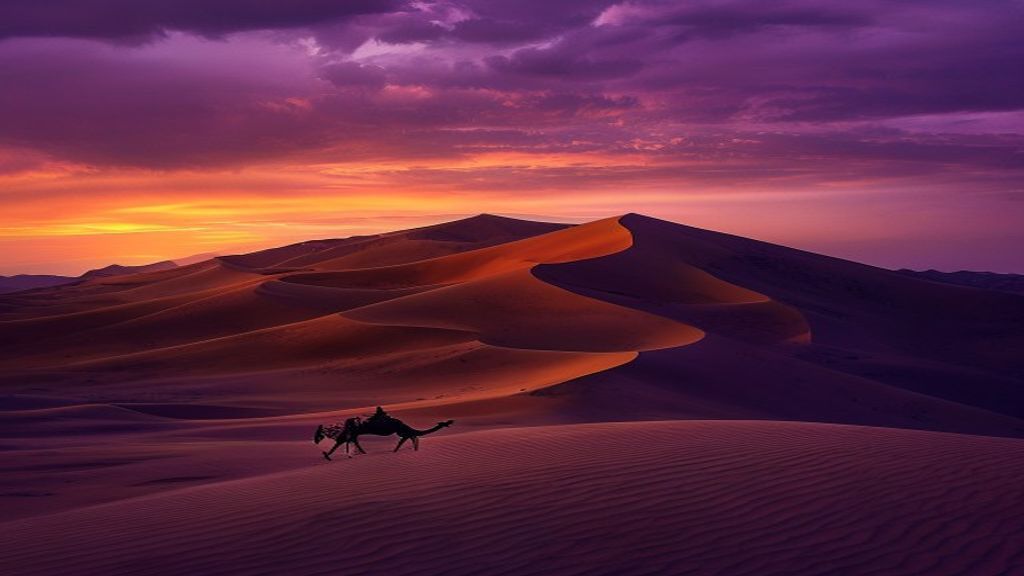
Sahara at Dusk: The Last Hour of Light
The Sahara does not ease you into its beauty. It withholds it all day — a vast, white-hot indifference stretching to every horizon — and then, in the final hour before dark, it releases everything at once.
This is what you came for. This is what everyone comes for, though most cannot say so precisely until the moment it begins.
The Long Wait in the White Heat
The desert between Merzouga and the great dunes of Erg Chebbi is flat and merciless at midday. The light is not warm here; it is surgical. It strips color rather than adding it, bleaching the sand to a pale cream, flattening the dunes into something that looks almost drawn rather than real.
You sit in the blue shadow of a canvas tent, drinking mint tea so sweet it sits in your chest like a small fire. The guide, a man named Brahim who has crossed this erg more times than he has counted, says nothing. He is watching the light the way a sailor watches the sea — not anxiously, but with the deep attention of someone who knows it will change, and knows exactly when.
The camels are couched nearby, their long lashes shutting against the dust. They are profoundly unbothered. You try to adopt this quality. You mostly fail.
The Hour the Desert Ignites
At around five o’clock — earlier in winter, later in the long June evenings — something shifts. It is not dramatic at first. A degree of warmth enters the light from the west. The white sand takes on the faintest blush, the way a cheek flushes before the rest of the face follows.
Then, over the next thirty minutes, the dunes begin to burn.
The shadows lengthen and deepen from pale grey to violet to a rich, bruised plum. The windward faces of the dunes glow amber, then copper, then a color for which English has no precise word — somewhere between orange and gold and the inside of a flame. The crests of the highest dunes catch the last direct sunlight and seem, for a moment, to be lit from within.
You climb. Everyone climbs. It is impossible not to. The sand gives way beneath your feet with a soft, dry whisper, one step forward, half a step back, thighs burning, breath short. When you reach the crest of the high dune and turn around, the world you came from — the tent, the camels, the scrubby acacia trees — has been swallowed by shadow and scale. You are standing on the spine of the earth.
What Silence Actually Sounds Like
At the top, the wind has stopped. Or perhaps it was never blowing here; perhaps the dune itself is the thing that makes wind possible below. The silence is not empty — it has texture and weight. It presses gently against your eardrums the way deep water does.
Far to the west, the sun is dissolving into a smear of cadmium and rose above the horizon. The sky directly overhead has turned a deep, saturated blue — not the blue of daytime but something richer, more intentional, the blue of a painter who has finally mixed the color right.
Brahim has climbed up behind you. He stands a few feet away and says, quietly and without drama: “Every night. Never the same.”
You believe him entirely.
After the Color, the Stars
Darkness in the Sahara does not creep in — it arrives decisively, and when it does, the sky cracks open. The Milky Way appears not as a smudge but as a structure, a thing with depth and density, a river of cold light running bank to bank above the dunes.
The desert, which spent all day threatening you with its heat and scale, now offers this — the oldest, most extravagant ceiling in the world, hung over warm sand still releasing the day’s warmth beneath you.
You lie back. The dune holds you perfectly. Somewhere to the east, a single drum begins to beat at the camp.
The Sahara, it turns out, does not withhold its beauty. It simply saves it for those who wait.