Sahara After Sunset
When the last light drains from the Sahara, the desert does not go dark — it ignites, layer by layer, into something infinite and breathtaking.
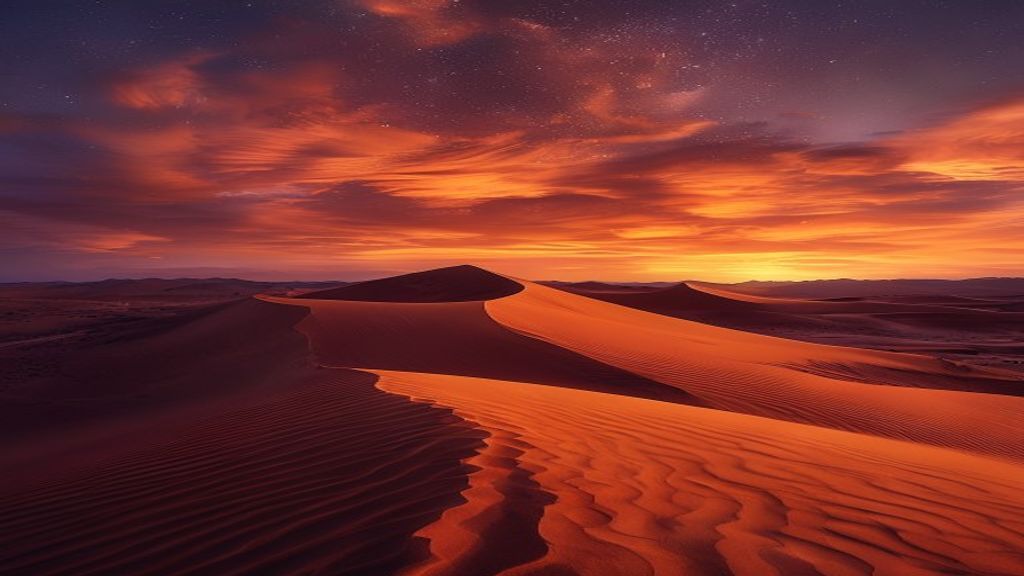
Sahara After Sunset
Everyone talks about the Sahara at midday — the white-hot brutality of it, the way the horizon bends with heat, the thirst that is more philosophy than sensation. But the desert’s real character does not emerge until the sun begins to fall. Then, in the space of an hour, the sand becomes every color it had been hiding all day.
The Hour of Gold
At four in the afternoon, the dunes near Merzouga cast shadows long as rivers. The light arrives at an angle so low and warm it seems almost liquid, as though the sun is pouring itself across the sand. Each ripple of the dune’s surface — carved by wind over weeks, or maybe decades — becomes a tiny ridge of shadow and light. The contrast is extraordinary: the windward face blazes copper and bronze, while the leeward slope sinks into deep purple shade. To stand at the crest of a tall dune in this hour is to feel briefly, improbably, like the last person on earth, and to find that feeling unexpectedly peaceful.
When the Colors Shift
There is a moment — it lasts perhaps three minutes — when the Sahara turns pink. Not the pale pink of tourist brochures. A deep, saturated rose that moves across the entire landscape simultaneously, as though the desert has inhaled. The sky above transitions through bands of color that have no names in English: something between apricot and ember at the horizon, bleeding upward into indigo, then into the first hard black of a sky about to reveal its full depth. The dunes seem to pulse with their own interior warmth during this transition, as though the day’s heat is surfacing through the sand in a long, slow exhalation.
The Stars Come Unannounced
There is no gradual twilight in the desert. One moment you are watching the last color drain from the west; the next, the stars are simply there — thousands of them, then tens of thousands, then a number that ceases to be a number and becomes instead a condition. The Milky Way does not arc overhead so much as it leans toward you, close and particulate, a river of light with visible texture. Without the contamination of city glow, the sky over the Sahara performs its oldest trick: it makes you feel very small and very present at exactly the same time.
The Sound of Silence, Revised
People say the desert is silent, but that is imprecise. What the desert has is an absence of human noise, which is different from silence. Wind moves across the crests of dunes with a faint, constant whisper. Sand grains shift and resettle, producing a sound like distant static. Somewhere below the audible register, the cooling sand makes sounds that you feel more than hear — minute contractions of the earth, a kind of slow breathing. You lie on your back, the still-warm sand radiating heat up through your spine, and you listen to the desert think.
Before the Dawn Patrol
At three in the morning, the temperature has dropped forty degrees from its midday peak. The cold is clean and absolute. But the sky — the sky is still doing its extraordinary work above you, unhurried, indifferent to comfort or inconvenience. A shooting star unzips a seam across Orion. The sand dunes, lit only by starlight, are visible as vast blue-grey shapes against the darker sky, their geometry simplified by night into something almost architectural. You pull your blanket tighter and decide, quite reasonably, that you will not sleep.
The Desert’s Promise
The Sahara teaches a particular lesson that softer landscapes cannot. It teaches that bareness is not emptiness. That the absence of detail forces a confrontation with scale, with time, with the bare fact of your own small warm existence inside an enormous and indifferent universe. And somehow — paradoxically, stubbornly — this confrontation feels not like diminishment but like relief. The desert holds nothing back. And so, for once, neither do you.