Morocco at Golden Hour: A City Built from Light
As the sun tilts toward the Atlas Mountains, Marrakech transforms — its ancient medina soaked in molten gold, its rooftops alive with color and call. This is the hour the city saves for itself.
Morocco at Golden Hour: A City Built from Light
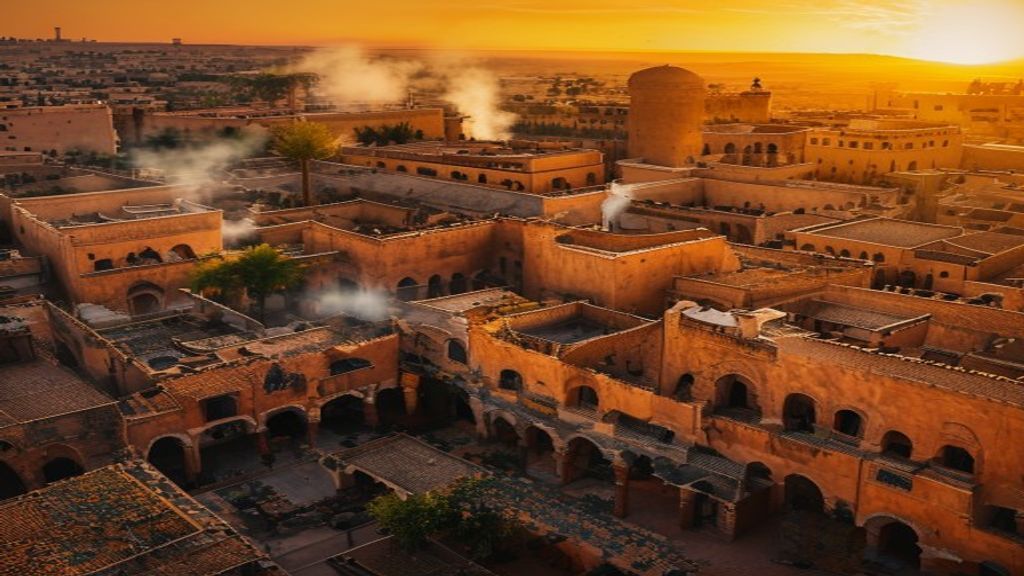
There is a precise moment — fourteen minutes wide, if you’re lucky — when Marrakech stops being a place you’re visiting and becomes a place that is happening to you. It arrives each evening without announcement, when the sun drops behind the Atlas Mountains and sends its last energy sideways across the city, and the medina — all that ochre and terracotta and dusty rose — ignites.
This is what you came for, even if you didn’t know it.
Morning: The Souk Before the Heat
But first, the morning. The souks of the medina wake slowly, their rhythms governed not by clocks but by light and heat. At seven, the dyers’ quarter hangs bolts of freshly dyed silk to dry — magenta, saffron, indigo — the colors violent against the pale morning sky. The smell is sharp and mineral, iron and dye, and beneath it all, the sweet vegetal rot of a city ten centuries deep.
In the spice stalls, pyramids of cumin and paprika and dried rose petals stand in geometric precision. The colors are so saturated they seem lit from within — amber bleeding into rust bleeding into the deep burgundy of ras el hanout. Sunlight finds its way through an overhead lattice and falls across the spices in shifting bars, as if the souk itself is a living thing breathing slowly.
Hands move across textiles. A brass lamp catches the light and throws a constellation across a mud-brick wall. Somewhere, tea is being poured from a height — that thin, glass-clear stream of mint and sugar that you will smell in your memory for years.
Midday: The Riad’s Secret Geometry
When the heat becomes a physical presence — a hand pressing on your shoulders — you retreat inside. The riad is Marrakech’s answer to the outside world: a fortress of silence and shade built around a central courtyard, its beauty deliberately hidden from the street.
The courtyard is a lesson in geometry and water. Mosaic tilework — zellige — covers every surface in patterns so intricate they approach the mathematical: interlocking stars in cobalt and white and sage, each tile hand-cut, each pattern a meditation on infinity. A marble fountain at the center murmurs quietly, sending small ripples outward that catch the light filtering down from the open sky above.
Orange trees stand in the four corners. Their fruit hangs like small suns. The air smells of jasmine and cool stone. Outside, the city roars. In here, there is only geometry and water and the sound of birds you cannot see.
Late Afternoon: The Tanneries
The leather tanneries of the Chouara quarter are best seen from above, from the terraces of surrounding shops. You lean over a railing with a sprig of mint pressed to your nose against the smell, and below you unfolds one of the most extraordinary sights in the traveling world.
Dozens of circular stone vats — some the width of bathtubs, some as large as swimming pools — are filled with dye in colors so pure they seem extracted from dreams: peacock teal, poppy red, honey yellow, the exact brown of dark chocolate. Workers move through the vats knee-deep, pressing and turning hides by hand, their movements ancient and practiced and unhurried.
At this hour, the late afternoon sun hits the vats at a low angle and the colors seem to vibrate. The whole quarter glows. You understand, suddenly, what it means to say a city is alive.
Golden Hour: Djemaa el-Fna
And then comes the light.
On the rooftop café above Djemaa el-Fna, the great central square of Marrakech, you watch it arrive. First the minarets catch it — the Koutoubia Mosque’s tower turning from pale stone to pure bronze in a matter of seconds. Then the square itself: the smoke from the food stalls turns gold. The canvas awnings glow amber. Every surface in the city seems to have been waiting for this exact quality of light to show what it truly is.
The call to prayer rises from somewhere inside the gold — a single voice, then another, then a chorus layering across the rooftops. Below in the square, the storytellers and musicians and acrobats are shadows against the brightness, the city performing for itself the way it has every evening for a thousand years.
You hold your camera. You lower your camera.
Some things are better witnessed than captured.
What Marrakech Keeps
You will leave with photographs that don’t quite explain it — the spice colors in flat light, the tilework without its shadows, the square without its sound. That’s fine. That’s the point.
Marrakech saves its best self for the fourteen minutes when the light is exactly right and you happen to be on a rooftop with mint tea going cold in your glass. It gives you just enough to understand what you missed, and exactly enough to need to come back.
The city has been doing this for ten centuries. It is very good at it.