Marrakech at Dusk: The City That Burns Gold
As the Moroccan sun surrenders to the horizon, Marrakech ignites — a labyrinthine city of copper light, spice smoke, and centuries of whispered secrets.
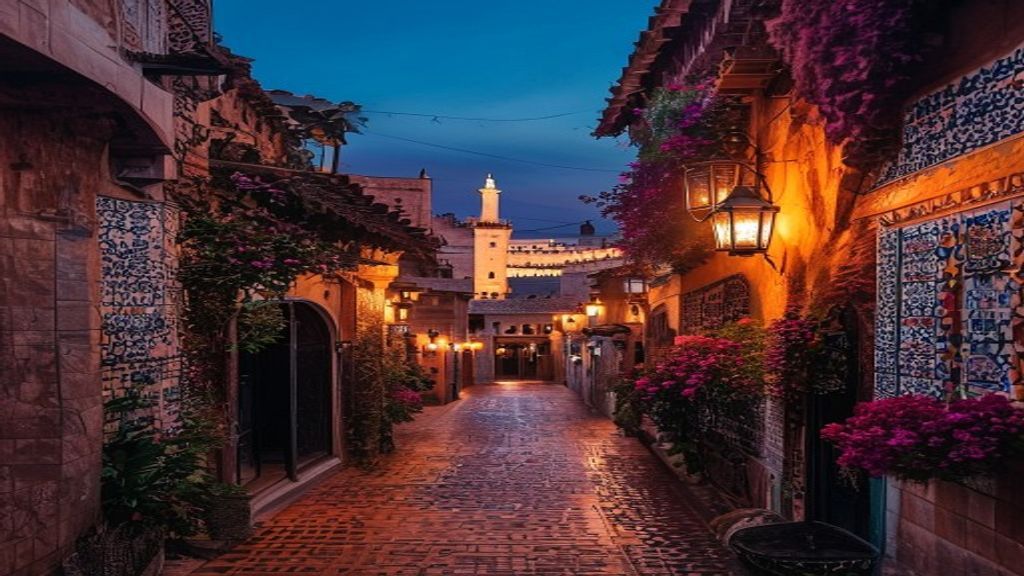
There is a moment, somewhere between late afternoon and nightfall, when Marrakech stops being a city and becomes something closer to a fever dream. The light does it. That particular Moroccan gold — thick and almost edible — pours through every crack in the medina walls, turning the ochre plaster into something that glows from within, as though the buildings themselves are lit by an ancient, interior fire.
The Hour Before the Call
It begins with the shadows. They stretch long and deliberate across the dusty lanes of the souks, reaching out from the stalls of leather babouches and hand-hammered lanterns like the fingers of something older than the city itself. The vendors slow their calls. The donkeys pause. There is a collective, almost imperceptible inhale — the medina holding its breath.
The air at this hour is a physical thing. It carries cumin and charred cedar smoke, the sweetness of fresh-pressed argan oil, the ghost of rose water left on warm stone. Walking through it feels less like moving and more like reading — each alley a sentence, each hidden courtyard a paragraph in a book written over a thousand years.
Into the Jemaa el-Fna
Then the square opens up, and everything shifts. Jemaa el-Fna at dusk is orchestral. The smoke from a hundred food stalls rises in thick columns, diffusing the last of the sunlight into something amber and impressionistic. Lambs turn on their spits. Bissara bubbles in iron pots. The aroma is enormous — layered, generous, unapologetic.
From the rooftop terraces that ring the square, the scene spreads out like a living mosaic. The rust-red minarets of the Koutoubia Mosque rise above the haze, steady and permanent, while below, everything pulses and wheels in beautiful disorder. Snake charmers coil their cobras. Acrobats arc through the smoky air. Storytellers gather their circles.
The Riad After Dark
To escape the square is to fall into another Marrakech entirely. Duck through a nameless doorway in a nameless alley, and suddenly there is silence, and a tiled courtyard open to the night sky, and the sound of a fountain playing softly to no one. Zellige tilework — geometric, obsessive, perfect — climbs every wall, catching the flicker of iron lanterns in ten thousand tiny reflections.
The night-blooming jasmine has opened by now. It fills the riad with a scent so concentrated it feels almost like color — white and green and impossibly sweet against the warm darkness. Mint tea arrives, poured from a silver pot held high, the stream catching the light like liquid glass.
What the City Keeps
Marrakech is not a city you visit so much as one you are briefly permitted to witness. It has been burning at this particular frequency for centuries — long before the tourists, long before the Instagram grids, long before anyone thought to call it magical. The magic, if that’s what it is, is indifferent to your arrival and unbothered by your departure.
You leave carrying the smell of it in your clothes and the geometry of its tilework behind your eyes. You leave, and for weeks afterward, at unpredictable moments — in the shower, at a traffic light, in the middle of an ordinary Tuesday — the scent of cumin smoke will find you, and for just a second, the light will turn gold.