Marrakech at Dusk: The City That Breathes Fire
As the sun melts into the Atlas Mountains, Marrakech transforms into a labyrinth of amber light and ancient ritual. This is a city that does not sleep — it simply changes its dream.
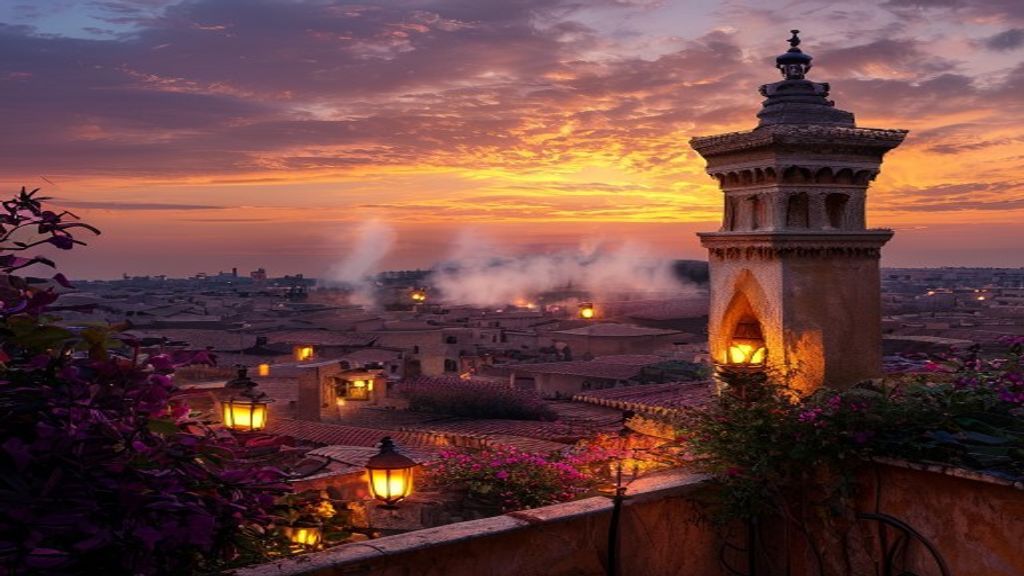
Marrakech at Dusk: The City That Breathes Fire
There is a moment, just before the call to prayer, when Marrakech holds its breath. The souks grow half-quiet. The smoke from the food stalls curls upward like incense. The sky above the medina turns the color of a blood orange pressed flat against the horizon, and for one suspended second, the city is neither past nor present — it is simply, overwhelmingly, alive.
The Medina Stirs
By four in the afternoon, the narrow alleys of the medina are a river of motion. Donkeys shoulder through gaps between humans. Women in djellabas carry baskets heavy with mint and preserved lemons. The smell of cumin and charcoal smoke drifts from doorways so low you must bow to enter — a humbling architecture, as if the city itself demands reverence.
The walls are the color of dried roses. Every surface is a decision: carved cedar, hand-painted tile, wrought iron lanterns swaying gently in a wind you cannot feel. You turn a corner and find a courtyard dripping with bougainvillea, magenta so violent it almost rings in your ears.
Djemaa el-Fna Ignites
Just before sunset, Djemaa el-Fna — the great square at the city’s heart — undergoes its daily resurrection. The snake charmers coil their cobras back into baskets. The fruit juice vendors wheel out their towers of oranges, halved and gleaming. Then come the food stalls, assembled with the precision of a military operation: smoking grills, lanterns strung overhead, the thunder of communal eating beginning its nightly overture.
The square does not invite you in. It swallows you. The drumbeats from the Gnawa musicians vibrate somewhere below your sternum. The scent of harira soup — tomato, lentil, preserved lemon — is so thick it is almost a texture. You sit on a wooden bench at a numbered stall, someone’s grandfather presses a bowl of snails into your hands, and you understand that you have not chosen Marrakech. Marrakech has chosen you.
The Hour of Lanterns
By eight o’clock, the riads — those inward-facing palace-homes hidden behind crumbling exterior walls — have lit their lanterns. Step through an unmarked door and the chaos of the medina evaporates. A central courtyard opens above you like a held breath: a mosaic fountain, the sound of water over tile, orange trees heavy with unripe fruit, and above it all, a square of cobalt sky salted with stars.
This is the great secret of Marrakech: the city wears its beauty on the inside. Its grandeur is private, turned inward, jealously guarded. The rougher the exterior wall, often, the more extraordinary the world behind it.
The Last Light on the Koutoubia
Walk west as the sun finally drops, and you will find the Koutoubia Minaret — twelfth-century, rose-stone, impossibly elegant — catching the last ten minutes of daylight in a way that feels almost embarrassingly cinematic. The palm trees in the gardens below go black against the orange sky. Pigeons spiral in wide, lazy arcs around the tower’s crown.
The call to prayer begins. It rolls across the rooftops in waves, overlapping voices from a dozen minarets, the city harmonizing with itself in a language older than any tourist has a right to fully understand. You stand there anyway, heart loose in your chest, and let it wash over you.
Some cities you visit. Marrakech visits you — long after you’ve gone home, it shows up in your dreams, smelling of rose water and woodsmoke, asking if you’re ready to return.