Marrakech at Dusk: Where the Smoke Meets the Stars
As the Moroccan sun melts into the rooftops of the medina, Marrakech exhales — a city of spice, shadow, and ancient amber light. This is the hour when the real city begins.
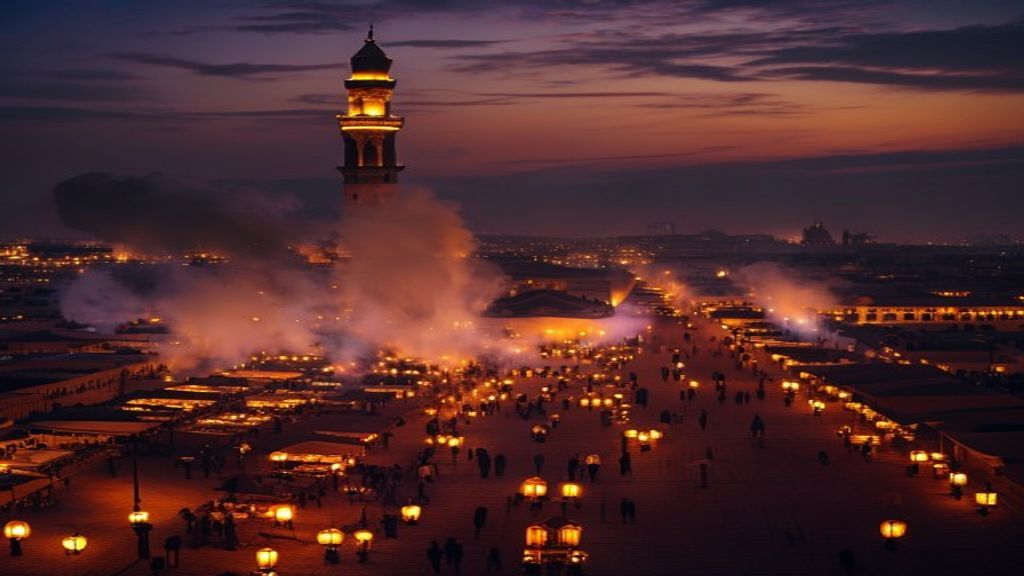
Marrakech at Dusk: Where the Smoke Meets the Stars
There is a precise moment in Marrakech — somewhere between the last call to prayer and the first lantern being lit — when the city stops performing and starts breathing. The tourists have retreated to their riads. The heat, which pressed down all afternoon like a heavy palm, lifts just slightly. And the medina, ancient and unapologetic, reclaims itself.
The Golden Hour in the Souks
The light arrives sideways through the latticework of the souk roof — thin blades of gold cutting through centuries of hanging dust. It catches the copper lanterns first, then the towers of saffron, the bolts of raw silk, the pyramids of rose petals drying in wooden trays. Everything glows. A cart stacked with blood oranges becomes a still life worth weeping over.
The smell comes before anything else: cumin and charcoal, leather being tanned in vats of pigeon dung and saffron water, sweet argan oil, the faint ghost of incense drifting from a doorway shrine. Your senses don’t queue up politely here — they collide.
Jemaa el-Fna at the Turning Hour
By the time you spill out onto the great square of Jemaa el-Fna, the transformation is underway. The snake charmers are coiling up their cobras. The acrobats are counting coins. And in their place, a small city of food stalls erupts — dozens of them, materializing from nowhere like a fever dream, each one crowned with smoke rising into the violet sky.
You choose a stool. Someone presses a bowl of harira into your hands without asking — thick, tomato-red, trembling with warmth. You don’t question it. The soup tastes like the city itself: deep, layered, slightly smoky, ancient in a way that language barely holds.
Above you, the minaret of the Koutoubia Mosque turns from sand-white to rose to a deep, bruised ochre as the sky darkens behind it. Swallows cut arcs around its crown like calligraphy.
The Riad After Dark
To retreat through a low wooden door into a riad is to understand the Moroccan philosophy of inside and outside — the city is for noise, for commerce, for God. The home is for silence, for water, for the self.
The courtyard fountain speaks in a constant, soft murmur. Orange trees press their scent into every corner. Zellige tilework — that endless geometry of turquoise and ivory and cobalt — catches the light of a single lantern and fractures it into something almost sacred.
You sit here for a long time. The sounds of the medina come over the wall, muffled and rhythmic, like a tide. Somewhere, someone is playing an oud — three notes, repeated, as if searching for a fourth that never comes.
What Marrakech Teaches
Marrakech does not offer itself easily. It does not curate its chaos for your comfort or stage its beauty for your camera. You earn the city by walking until you’re lost, by saying yes to the soup you didn’t order, by sitting in the square until the smoke stings your eyes and the stars appear above it.
And then — only then — does it show you something true: that beauty here is inseparable from rawness, that warmth and overwhelm are the same sensation, and that the best light always comes just before the dark.