Lisbon After Rain
When the cobblestones of Alfama glisten after a winter storm, Lisbon reveals a quieter, more tender version of itself — a city that breathes between the notes of a fado song.
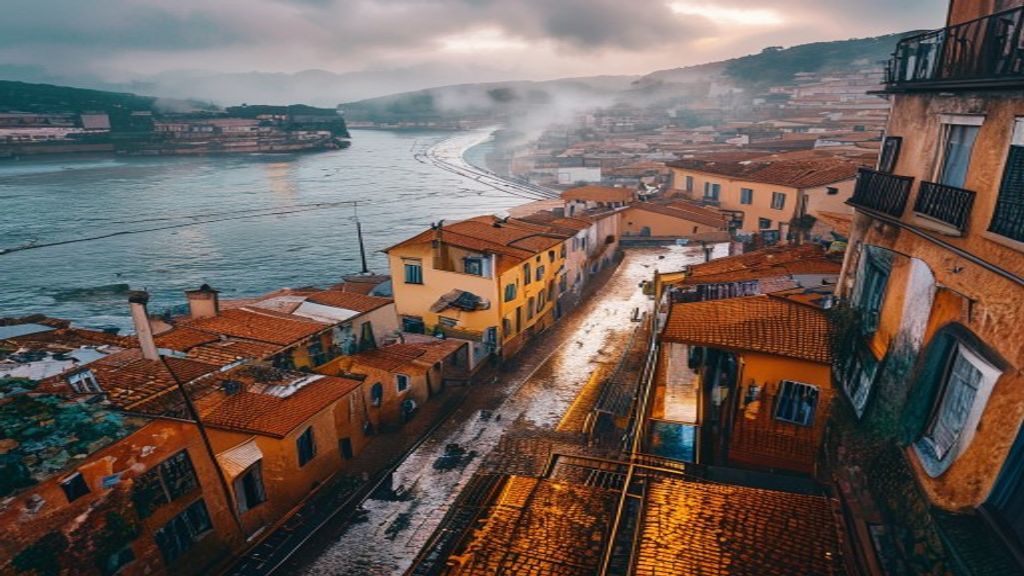
Lisbon After Rain
There is a particular kind of light that only exists in Lisbon after the rain has passed — a soft, silver-gold light that seems to rise from the wet cobblestones themselves, as if the city is lit from within. The clouds pull apart like torn fabric, and for a few luminous minutes, everything glows.
The Miradouro at First Light
We arrived at Miradouro da Graça before the tour groups, before the espresso carts, before the city had fully decided to wake up. A thin mist was still unraveling itself from the Tagus below. The river, wide and ancient and the color of hammered pewter, moved without urgency toward the Atlantic. Somewhere down the hill, a church bell marked the hour in slow, bronze strokes. A cat — orange, unhurried — picked its way across a mosaic bench and settled beside us as if we were old acquaintances.
The red rooftops of Alfama spread downhill in a slow cascade, clay tiles darkened by the night’s rain, their colors deepening from terracotta to something closer to rust, to blood orange, to amber. Every shade of warmth stacked against the pale morning sky.
Into the Alfama
To walk into Alfama after rain is to walk through a living watercolor. The azulejos — those obsessive, glorious blue-and-white tiles — bleed a little in the wet, their geometric patterns shimmering. Laundry hangs between buildings like signal flags of daily life: a striped towel, a child’s yellow shirt, a pair of linen trousers swaying slowly above a staircase so steep it functions more as a ladder than a road.
The alley smells of petrichor and espresso and something frying — salt cod, almost certainly, because in Lisbon it is always salt cod. A grandmother leans from a second-floor window, not doing anything in particular, just watching the street the way people once watched fires or rivers, as a form of meditation.
The walls here hold more history than the museums. Look closely at a peeling facade and you will find three centuries of paint, each layer a different decade’s optimism. Ochre beneath white beneath green. The city is an archaeological site you live inside of.
Fado Heard Through a Wall
In the late afternoon, tucked inside a tasca barely larger than a pantry, we heard it: fado. Not a performance for tourists, but something accidental and private — someone in the kitchen or the back room, a voice that had no interest in being heard beyond these walls. The song was all longing and surrender, the Portuguese concept of saudade made audible: a love for something you can’t quite name, a homesickness for a place you’ve never left.
The music stopped. The rain started again, lightly this time, tapping on the awning in an irregular rhythm. We ordered another glass of Vinho Verde and didn’t move for a long time.
The Tram Tracks at Dusk
By evening, the 28 tram lines glinted under the streetlights like twin rivers of gold running uphill through impossible inclines. The tram itself — ancient, yellow, rattling with aristocratic dignity — disappeared around a corner with a sound like a music box winding down.
The miradouros filled with people as the sky turned colors it had no business turning: violet and apricot and a deep, bruised rose. Someone opened a bottle of wine on a stone wall. A guitar appeared. The Tagus below went dark and mirror-flat.
Lisbon does not ask for your attention. It simply earns it, slowly, the way water earns its way through stone — not through force, but through patient, endless return.