Kyoto in the Rain: A City That Breathes Slowly
When the rain arrives in Kyoto, the ancient city doesn't retreat — it deepens. A quiet photo essay through bamboo groves, moss-covered temples, and lantern-lit alleys on a wet spring afternoon.
There is a particular kind of silence that belongs only to Kyoto when it rains. Not the silence of absence, but of presence — of the world pulling inward, breathing slower, turning its face toward the grey sky and asking nothing of you.
We arrived on a Tuesday, which felt appropriate. Kyoto is a Tuesday kind of city. Not the loud, blazing weekend of Tokyo, but something more deliberate, more considered. The bullet train had carried us through rice paddies slicked with water and mountains half-swallowed by cloud, and by the time we stepped onto the platform at Kyoto Station, the rain had already settled in for the day.
The Temple Before the Crowds
Fushimi Inari at 6 a.m. in the rain is an entirely different place than the one in the photographs. The vermillion torii gates — hundreds of them, marching upward into the cedar forest like the spine of some ancient creature — were slick and darker than you’d expect, the red deepened to something closer to burgundy. Steam rose faintly from the stone path. The cedar trees dripped. Somewhere above us, invisible in the mist, a crow called once and was answered by nothing.
We walked slowly. There was no reason to hurry. The gates closed behind us like a corridor drawing shut, and with each step higher, Kyoto dissolved below into a white softness, the city becoming an idea rather than a fact.
Moss crowded the bases of the gate posts in impossible shades of green — the kind of green that seems lit from within, that makes you wonder if colour is something the eye sees or something the body feels.
Arashiyama: The Bamboo Speaks
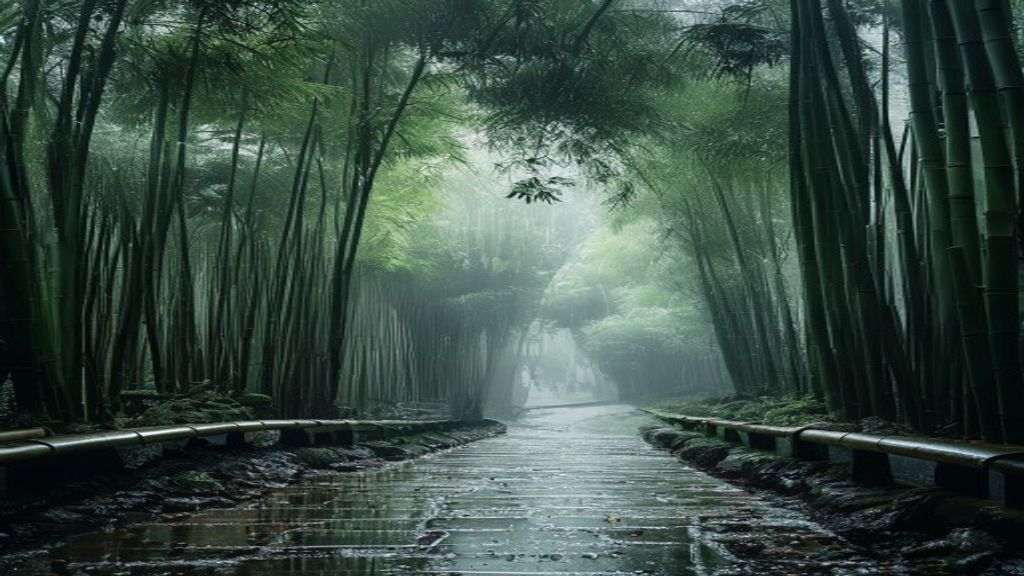
By mid-morning we had crossed the city to Arashiyama, where the bamboo grove waits at the end of a narrow lane lined with tea houses and souvenir shops still pulling up their shutters. In the rain, the tourists had thinned. A vendor was arranging persimmons under a blue awning. A cat watched us from a stone wall.
The bamboo grove is one of those places that resists photography. Not because it isn’t beautiful — it is almost unbearably beautiful — but because beauty here is not visual. It is auditory. The sound of ten thousand bamboo stems swaying and knocking against each other in the wet wind is something between wind chimes and applause, between a lullaby and a warning. You stand inside it and feel small in the best possible way.
The sky above the grove was white, and the bamboo faded upward into that whiteness, so that it seemed to grow not toward the light but into it, dissolving at the tips like a watercolour painting left in the rain.
Gion at Dusk
The rain softened toward evening but didn’t leave. In Gion, the old geisha district, the stone-paved lanes glistened under paper lanterns that had just begun to glow orange and amber against the coming dark. The wooden machiya townhouses stood shoulder to shoulder, their latticed facades holding the warm light inside like secrets.
Puddles on the cobblestones held upside-down lanterns, upside-down eaves, upside-down versions of everything — a perfect, liquid Kyoto existing just beneath the surface of the real one. We stood at a corner and watched a white cat walk the length of a low garden wall, indifferent to the rain, indifferent to us, certain of its own belonging in a way that felt instructive.
Somewhere inside one of those wooden buildings, someone was playing a shamisen. The notes came through the wall thin and plucked and ancient, winding out into the wet lane and dissolving in the dark.
What the Rain Teaches
Kyoto in the rain teaches you to slow down not because it demands it, but because the city itself has already slowed, and you can either fall into its rhythm or spend the whole day fighting a current that will not bend for you.
We chose to fall in. We drank matcha in a room with paper walls and listened to the rain on the roof tiles. We walked without destination. We let the city be old in front of us without trying to extract anything from it.
Some places, you visit. Kyoto, in the rain, on a quiet Tuesday — Kyoto visits you.