Kyoto in the Rain: A City Revealed by Stillness
When the crowds dissolve and the cobblestones turn dark and wet, Kyoto exhales — a city of lanterns, moss, and quiet centuries finally allowed to breathe.
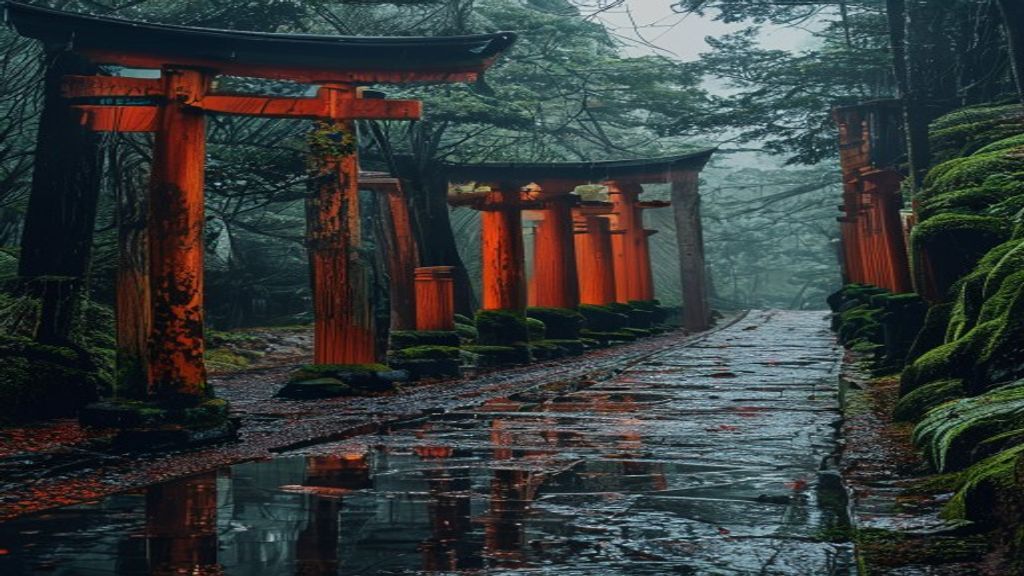
There is a version of Kyoto that most people never see. It lives behind the postcard — behind the rows of tourists posing in rented kimono, behind the tour-bus schedules and the perfectly timed cherry blossom itineraries. To find it, you must arrive on a grey Tuesday in May, when the plum rains settle over the Higashiyama hills like a soft exhalation, and the city decides, at last, to be itself.
The Hour Before the Shrines Open
The alarm reads 5:12 a.m. Outside the ryokan window, the lane is a mirror. Every stone lantern doubles itself in the pooled water below, each flame-shaped glow trembling as a raindrop strikes the surface and breaks the reflection apart. The air smells of cedar, wet earth, and something older — incense carried on humidity, soaked into the timber bones of buildings that have stood here for three hundred years.
Fushimi Inari is empty at this hour. The vermillion torii gates ascend the forested hill in their thousands, and walking beneath them alone feels less like sightseeing and more like passing through chambers of a long, slow dream. The wood is lacquered and brilliant even in the pewter light. Moss creeps along the base of each post. A crow calls once from somewhere high in the cedar canopy, and then there is only rain.
Nishiki Market in the Drizzle
By mid-morning, the covered arcade of Nishiki Market is alive — but gently so. Vendors arrange pickled vegetables in lacquered trays: pale daikon, electric-purple turnip, ghost-white ginger fans. Steam rises from vats of tofu simmering in dashi. An elderly woman in a plastic rain bonnet examines a bundle of sansho leaves with the focused attention of a jeweler appraising a stone.
You eat standing up: a skewer of grilled mochi glazed with sweet soy, its surface charred in tiger stripes, its interior yielding and warm. The sugar hits your blood like sunlight. Outside, the rain taps a patient rhythm on the canvas awning.
Philosopher’s Path at Dusk
The canal path known as Tetsugaku-no-Michi — the Philosopher’s Path — earns its name best on an evening like this. The cherry trees that line the waterway are long finished flowering; their leaves are a deep, saturated green, heavy with rain, nodding over the narrow stream. The water runs fast and clear over smooth stones. A single heron stands at the edge, motionless, the colour of old pewter, as still as a brushstroke in a Zen painting.
There are no crowds. There is only the sound of water, the distant temple bell marking the hour, and the feeling — rare and precious in modern travel — of being genuinely, completely present in a place that has no interest in performing for you.
What Rain Gives Back
Kyoto in the rain is an argument for slowness. It is a reminder that the best version of any place is rarely the one captured on the most-liked photograph. It is found instead in the condensation on a ceramic tea bowl, the way tatami absorbs silence, the particular quality of light that filters through shoji screens on a cloudy afternoon — diffuse, directionless, infinitely soft.
Leave the umbrella at the ryokan. Walk until your shoes are soaked and your coat smells of rain and cedar. Let the city be grey and dripping and extraordinary. You will not regret it.