Kyoto in the Mist: A Morning Among Ancient Stones
Before the city wakes, Kyoto belongs to the fog — drifting between torii gates, softening temple rooftops, and turning the ordinary into something sacred. A quiet walk through stillness and centuries.
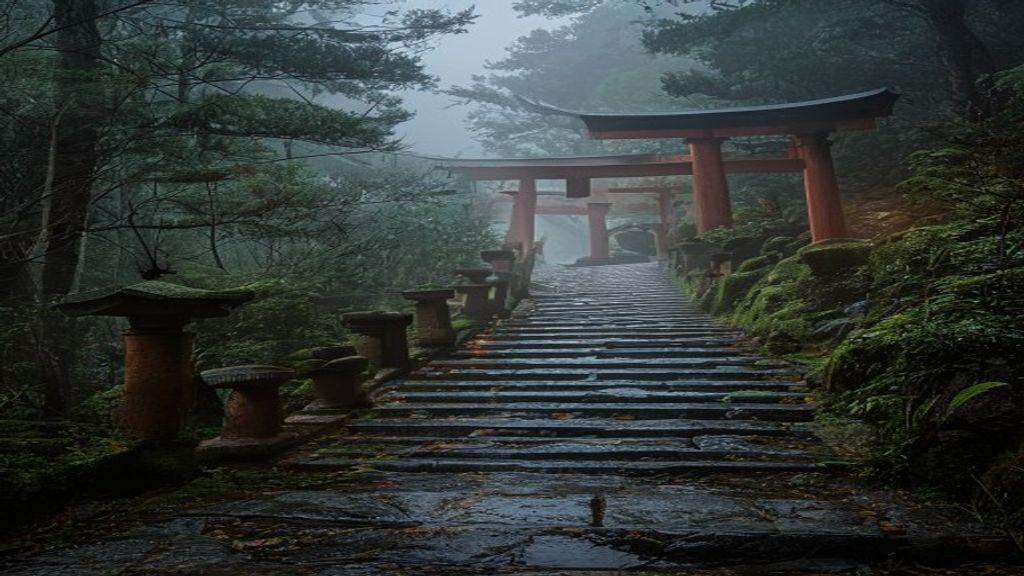
There is an hour in Kyoto — somewhere between four and five in the morning — when the city holds its breath. The lanterns along Ninenzaka still glow, but no one passes beneath them. The cobblestones are dark and wet from overnight rain, reflecting amber light in long, trembling ribbons. A crow calls from somewhere behind a temple wall, and then: silence again.
This is when Kyoto becomes itself.
The Gates Before Dawn
Fushimi Inari reveals its true nature to those willing to meet it in darkness. The thousands of vermillion torii gates — so familiar from every guidebook, every Instagram grid — shed their touristic skin in the pre-dawn hours. Walk deep enough into the mountain path, past the last food stall and the last lantern, and the gates become something older. Their red deepens to something almost burgundy in the low light. Moss breathes on stone pedestals. The air smells of cedar, damp earth, and incense carried on a wind from nowhere.
Your footsteps are the only sound. Your breath makes small clouds.
Stone Gardens and Still Water
By six, a thin mist has settled over the Zen gardens of Ryōan-ji. The famous rock garden — fifteen stones arranged in three groupings across a sea of raked white gravel — appears and disappears as the fog moves. One moment you see all fifteen. Then the mist thickens, and there are only seven. Then twelve. It feels less like a riddle and more like a lesson: some things cannot be held all at once.
The moss garden beyond it is soaked and luminous, every shade of green amplified by moisture. Water drips from maple leaves in irregular rhythms, and the sound is more musical than anything composed.
Tea and Tatami
A small machiya guesthouse near Gion serves breakfast on a low lacquered table — miso soup still steaming, pickled plum the color of a bruise, rice shaped into a neat mound. Through the paper screen, the interior garden is barely visible: a single stone lantern, a bamboo water pipe dripping into a basin, a red maple just beginning to leaf.
You eat slowly. There is nowhere to be, and that, in itself, feels like a gift.
The City Wakes
By eight, Kyoto has found its rhythm. Temple bells ring across the rooftops — not in unison, but in conversation, each neighborhood’s bell answering another’s from a different distance. Monks in gray robes move along a canal path, heads down, unhurried. A bicycle passes with a basket of white chrysanthemums. A grandmother sweeps the step of her narrow house with a broom the color of dried grass.
The mist has burned away now, and the mountains that ring the city — Higashiyama, green and ancient — catch the first hard light of the morning sun. The gold of temple rooftop ornaments flickers once, twice, like signals from another era.
Kyoto does not ask you to understand it. It asks only that you slow down enough to feel its weight — the accumulated quiet of thirteen centuries pressing gently against the present, reminding you that beauty, like fog, is best appreciated before you try too hard to see it.