Kyoto in the Hour Before Snow
In the strange, suspended stillness before a winter snowfall, Kyoto's ancient temples and bamboo groves hold their breath — and the world becomes a ink-wash painting come to life.
Kyoto in the Hour Before Snow
There is an hour in Kyoto, in the deep of winter, when the sky turns the color of unpolished silver and the air takes on a particular pressure — a held-breath feeling, as if the city itself knows what is coming. The tourists have retreated to their ryokans. The monks have shuttered the outer gates. The bamboo in Arashiyama stands perfectly, impossibly still.
This is the hour before snow.
Fushimi Inari Before Dawn
We set the alarm for four-thirty. No one tells you to do this; it is the kind of knowledge that passes between serious travellers in whispers. The ten thousand torii gates of Fushimi Inari Shrine climb the mountain in an unbroken tunnel of vermillion, and in the daytime they are magnificent. But before the city wakes — in the blue-black cold of a winter predawn — they are something else entirely.
The lanterns along the path cast pools of amber light. Each gate threw a long orange shadow behind it. Our footsteps on the gravel sounded enormous. Halfway up the mountain, we stopped. Below us, Kyoto’s lights blinked through the mist like something dreamed. Above, the gates curved upward into darkness.
We stood there for a long time, saying nothing, watching our breath rise and disappear into the cold air.
The Philosopher’s Path in Winter
The Tetsugaku-no-Michi — the Philosopher’s Path — runs along a narrow canal in the Higashiyama district, shaded in spring by cherry blossoms. In winter, stripped bare, it reveals something more honest and more beautiful: the dark architecture of branches against a pale sky, the slow-moving canal reflecting whatever light remains, moss-covered stones and stone lanterns growing from the earth as if they had always been there.
We walked it slowly, as the name demands. The canal held a thin skin of ice at its edges. A grey heron stood on a stepping stone, motionless, its patience immeasurable and instructive. There is a kind of philosophy in that stillness — an argument for simply being where you are, without agenda.
The first flakes began to fall just as we reached Nanzen-ji Temple.
Snow at Nanzen-ji
Nothing prepares you for the scale of Nanzen-ji’s sanmon gate when you turn a corner and it suddenly fills your entire field of vision — three stories of ancient cypress wood, rising from the gravel like a declaration. In the snow, it was almost hallucinatory.
The flakes fell slowly, indifferently. They settled on the curved eaves of the main hall without a sound. They collected in the mossy furrows between the flagstones and dusted the tops of the stone lanterns. Within minutes, the garden had become a monochrome world: black pine branches, white ground, grey sky, the dark timber of the temple buildings.
A single maple leaf, still clinging to its branch from autumn, burned red against all that white. It seemed almost unreasonable.
Arashiyama: The Bamboo Speaks
We took the train west as the snowfall intensified. Arashiyama in winter snow is something that photographers attempt and words fail — and yet here we are, trying.
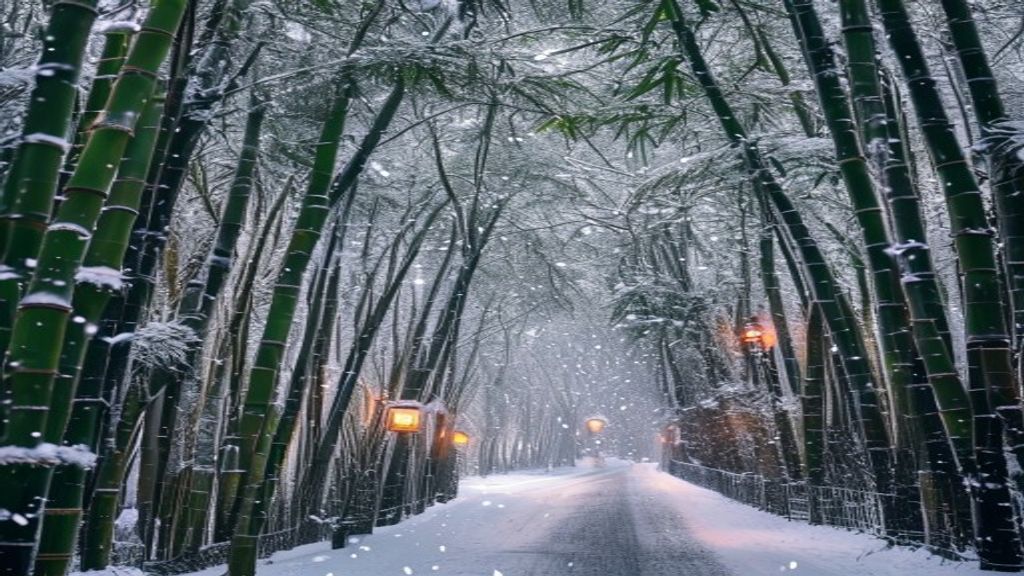
The bamboo grove is not silent; that is the first surprise. The stalks creak and whisper against each other, a sound like an enormous breathing organism. In the snow, the green of the bamboo becomes almost fluorescent — saturated, electric, utterly out of place and utterly correct. The white ground between the stalks is unmarked. The world narrows to a corridor of green and white, and at the end of it: more corridor, infinite and beckoning.
We walked to the Ōi River and watched the snow fall into the water and disappear. On the opposite bank, the mountains of Sagano were dissolving into cloud. A small wooden boat was moored at the riverbank, filling slowly with snow.
The Tea House
At dusk, half-frozen and completely undone by beauty, we found shelter in a machiya tea house near Gion. The tatami floor. The low lacquered table. The sound of water heating in an iron kettle.
The woman who brought our matcha said nothing, but she smiled at our wet coats and our red-tipped ears, and there was something in that smile — a shared understanding of what the day had been, of what the city had given us.
Outside, Kyoto disappeared into the snow. We wrapped both hands around our bowls and drank.
Kyoto in winter does not perform for you. It does not offer the spectacle of cherry blossoms or the crowds of autumn leaves. What it offers instead is something harder to name and more difficult to forget: the feeling of walking inside a painting, of moving through time, of being briefly, quietly, held by a city that has seen everything and forgotten nothing.