Kyoto in the Hour Before Dawn
Before the city wakes, before the first tourist bus arrives, Kyoto belongs to the moss and the mist and the three-hundred-year-old silence of its garden stones. This is how to find it.
Kyoto in the Hour Before Dawn
The alarm goes off at four-fifteen and nothing about it feels spiritual. The hotel room is dark and the November air pressing against the window is cold in the serious, sincere way of Japanese cold — it means what it says. But there is a kind of Kyoto that does not exist after seven in the morning, and to find it you must leave warmth behind.
The Streets of Gion Before Light
Gion at four-thirty in the morning looks like a film set that has been left running without actors. The paper lanterns outside the ochaya teahouses glow amber, suspended above empty stone lanes. The willow trees along the Shirakawa Canal trail their fingers in the dark water. Everything is still, the way things are still in a held breath.
The canal smells of stone and slow water and faintly of something floral — late-season chrysanthemums in a bucket outside a closed shop. The wooden machiya townhouses on Hanamikoji-dori stand shoulder to shoulder in the dark, their latticed wooden facades sealed and quiet, storing whatever century they prefer inside.
Your footsteps sound unreasonably loud. The cobblestones are uneven and each step shifts slightly, a subtle reminder that you are walking on something very old. In the winter dark, with the lanterns and the canal, Gion achieves the thing it is always gesturing at in daylight, under tourist cameras and selfie sticks: it achieves the past. Not a costumed version of it. The real thing, or close enough that your nervous system can’t tell the difference.
The Philosopher’s Path at Mist-Rise
An hour by foot brings you north to the beginning of the Tetsugaku-no-Michi — the Philosopher’s Path — named for the Zen Buddhist scholar Nishida Kitaro, who walked it every morning in meditation. In April this canal-side footpath is wall-to-wall cherry blossom, photographed nine million times per year. In November, before dawn, it is entirely yours.
The maples on either side of the canal are on fire even in this light — or perhaps especially in this light. Dark red and amber and one tree, one specific tree near the midpoint of the path, that has turned a color for which English doesn’t quite have a word: somewhere between scarlet and rust and the interior of a coal when the flame first catches.
Mist has come off the water overnight and settled into the path in low drifts. It shifts when you walk through it. Somewhere in the canal, an invisible bird is conducting a brief, serious musical argument with the dark. The stone lanterns at the shrines flanking the path are beginning to dim — the automatic timers clicking the ancient world back into standby as dawn approaches.
You stop. You stand completely still. The mist moves around your knees.
This is what the philosopher walked through, more or less. This exact quality of silence, this precise coolness, this moss on this stone wall. The canal has been here since 1890. The maples do not know about tourism. The mist has no opinion about Instagram.
First Light at Fushimi Inari
You take the Keihan line south as the city begins its first stirrings — delivery trucks, a man in a business suit walking with enormous purposeful strides, a combini already fluorescent and transactional in the grey pre-dawn.
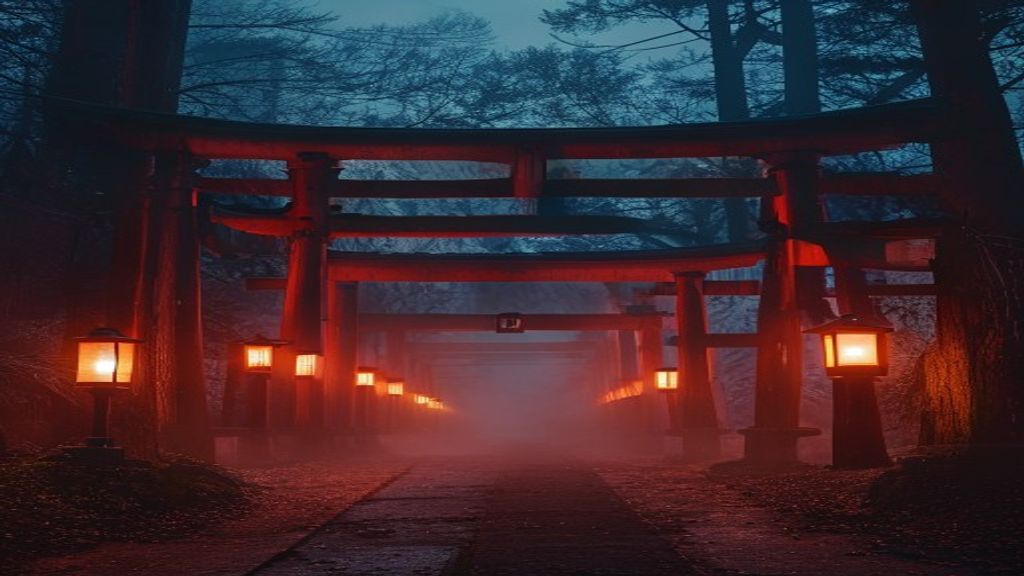
Fushimi Inari Taisha receives five million visitors a year. In the two hours after it opens at six a.m., it receives a significant fraction of them. But now, at five-forty, the first of the ten thousand vermilion torii gates opens onto an empty mountain.
The color is extraordinary. In daylight, the orange-red of the torii is vivid but also somehow expected — you’ve seen the photographs. In the blue-grey light of pre-dawn, with ground fog moving between the columns of gates and the cedars pressing close on both sides, the color does something different. It glows, internally, the way embers glow. Each gate casts a faint warm shadow on the next.
You walk upward through tunnel after tunnel of red. The gates overlap, their shadows creating a strobing, hypnotic rhythm. The mountain is breathing — literally, almost: the cedars release cold air in quiet exhalations, the mist condenses and falls from branches in single drops that sound, in the silence, like footsteps.
A fox — a kitsune, sacred to Inari, the god of rice and foxes and industry — stands at a bend in the path. It looks at you with the absolute composure of something that has been worshipped for a very long time. Then it turns and disappears into the dark between the gates.
The City Waking Below
By the time you descend, the sun has committed. It comes in low over the Higashiyama mountains, flooding the basin of the city gold. Kyoto spreads below in its grid — a city that survived both the sword and the bomb through geographical mercy and political argument, a city that kept its temples when others lost theirs.
From this height, in this light, you can almost see it all at once: the rooftiles and the pagodas and the distant silver thread of the Kamo River and beyond it the mountains that ring the city on three sides like cupped hands. The city that preserved everything so that the rest of the world could come and remember what it was trying to forget.
Your feet hurt. You are out of coffee. The first tour group is arriving at the base of the mountain, its guide’s flag lifted in the clear morning air.
You had it first. You had it alone, in the mist, in the dark, before any of this. That’s the whole trick, and it’s worth every cold, unreasonable minute of it.