Kyoto in the Blue Hour
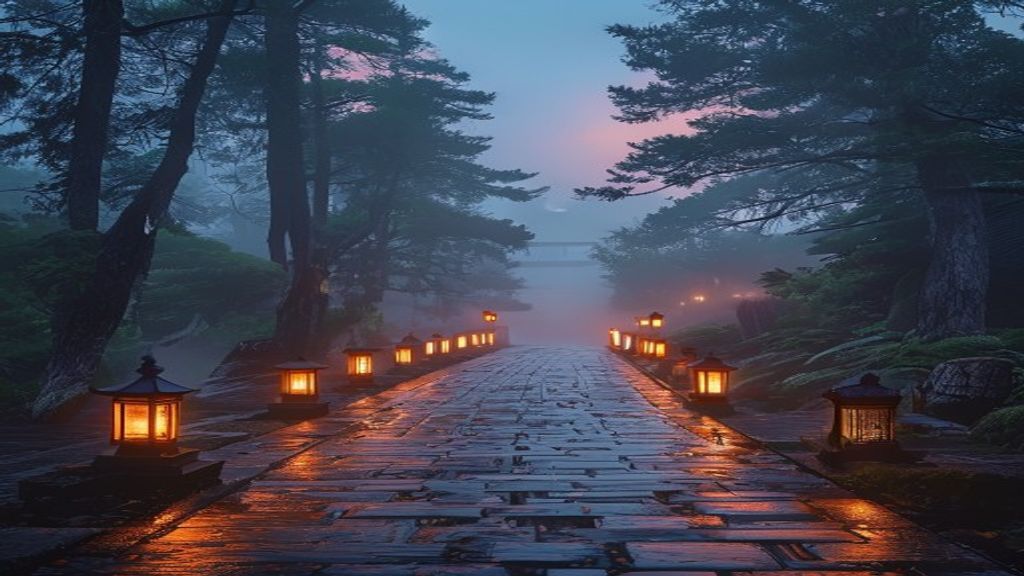
Before the city wakes, Kyoto exhales — a quiet world of lantern-lit cobblestones, silver mist, and temples holding their breath. This is the city that belongs to no one, and everyone, in the hour before dawn.
Kyoto in the Blue Hour
There is a particular silence that lives inside Kyoto before the sun arrives. It is not the silence of emptiness, but of waiting — the way a held breath feels just before a word is spoken. The stone lanterns still glow along the paths of Fushimi Inari. The crows have not yet started their arguments in the cedar tops. The city is yours, entirely, if you are willing to rise while the sky is still the color of a bruised plum.
The Streets of Higashiyama at 5 A.M.
The cobblestones on Ninenzaka are slick with dew. Wooden shopfronts stand shuttered and patient, their noren curtains tucked away for the night, their smell of incense and roasted tea still hanging faintly in the cold air like a memory of yesterday’s tourists. Your footsteps are the only sound. Each step rings against the stone with a clarity that feels almost rude to the hush around you.
The sky overhead shifts through impossible gradients — indigo giving way to the faintest suggestion of violet, then a thin blush of coral pressing up from behind the Higashiyama mountains. A single crow calls once and falls silent, as if it, too, is embarrassed to disturb the moment.
Kinkaku-ji Before the Crowds
The Golden Pavilion at dawn does not look real. It looks like something a poet invented during a fever — three tiers of gilded wood hovering above a mirror-flat pond, so perfectly reflected that you cannot be entirely sure which direction is up. The mist sits low across the water, threading between the sculpted pines, blurring the boundary between the pavilion and its ghost.
A single maple at the garden’s edge has begun its slow turn toward autumn red, one blazing branch against a sky still deciding between night and day. You stand at the viewing rail without speaking, without needing to. Some places make language feel inadequate, and this is one of them.
The Tea House at the Edge of the Forest
There is a small tea house near the back of the Arashiyama bamboo grove that most visitors never find, because most visitors arrive at ten in the morning when the paths are already crowded four abreast. In the blue hour, you find it by following the smell of charcoal smoke — someone inside is already heating water, already preparing for the day.
Through the paper screen, warm amber light pulses gently. Outside, the bamboo trunks rise in their thousands, straight as green columns holding up the pewter sky, their hollow clatter a sound like no other on earth — wooden wind chimes played by a breeze you can barely feel on your face. The sound comes from everywhere and nowhere. You could stand here until the light turns gold, until the first tour buses arrive and the spell is broken.
The Moment the City Remembers Itself
At around 6:15, it happens. A monk in grey robes passes without acknowledging you, his sandals barely whispering against the path. A shopkeeper slides open a wooden shutter with a long, resonant crack. Somewhere a bicycle bell rings twice. The crows find their voices all at once.
Kyoto is waking up, folding away its private self, preparing to become the postcard again. But you saw the other version — the one that lives beneath the tourism and the ceremony, the city that is simply ancient and breathing and unconcerned with being beautiful.
That version, you carry with you. No photograph required.