Kyoto in November: When the Maples Let Go
For one brief, burning week each November, Kyoto's ancient temples are swallowed by fire — not the destructive kind, but the slow, glorious combustion of autumn maples igniting in crimson and gold. To witness it is to understand why the Japanese have a word, *momiji*, dedicated to this single, fleeting moment.
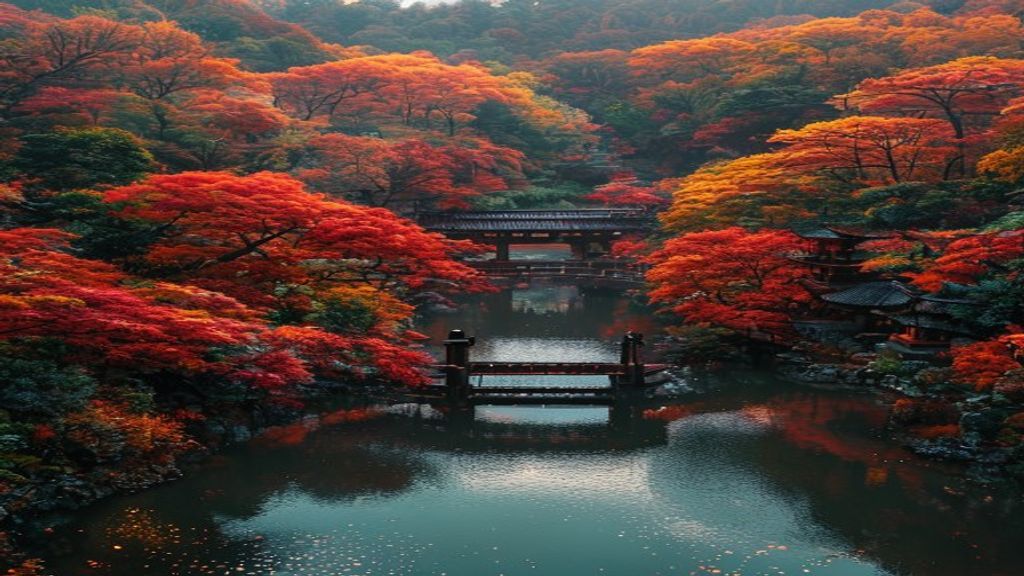
The Japanese have always understood that beauty is inseparable from impermanence. Mono no aware — the pathos of things, the gentle ache of watching something exquisite pass — is woven into the national aesthetic like thread into silk. Nowhere is this felt more acutely than in Kyoto in November, when the maple trees decide, all at once, to burn.
First Light at Tofuku-ji
Arrive before the gates open. In the predawn dark, the gravel paths of Tofuku-ji are empty and pale, and the maples above are black shapes against a sky going from charcoal to ash to the faintest bruised rose. Then the light comes — low, amber, angled — and the trees ignite.
The word momiji means both “maple” and the act of leaves turning red. The Japanese language knew these two things were the same thing. Standing beneath the Tsutenkyo bridge as the canopy overhead shifts from green to amber to a red so saturated it seems electric, you know it too.
Leaves fall. Each one spirals down in its own particular way — some straight and deliberate, some lazy and wandering. They collect in the garden below in drifts of vermillion and rust. A monk in grey robes crosses the bridge and does not look up. He has seen ten thousand of these mornings. He is still here.
The Philosophers’ Path, Leaf by Leaf
By mid-morning, walk the Tetsugaku no Michi — the Philosopher’s Path, a canal-side stone walk named for the thinker Nishida Kitaro, who is said to have strolled it daily in meditation. In spring it is famous for cherry blossoms. In November it belongs entirely to the maples.
The canal runs dark and still. Leaves have gathered on its surface in a mosaic, floating slowly southward toward the city. On either bank, the trees press close, their canopies intertwined overhead into a tunnel of amber. The light that reaches the path has already passed through several layers of color — it arrives golden, warm, transformed.
You fall into the rhythm of it without meaning to. One foot, then the other. Crunch of a dry leaf underfoot. The distant sound of a temple bell — three low, resonant pulses that seem to come from inside the chest rather than outside.
Rain at Arashiyama
In Arashiyama, rain falls fine and cold through the bamboo forest, and the maples along the Oi River become something else entirely — deeper, more saturated, almost unreal in their redness against a sky gone flat and silver. No photograph ever captures this. Every photographer tries anyway.
The Togetsukyo Bridge spans the river in a single arching sweep, its wooden railings dark with rain. On the far bank, the hills rise in layers — foreground crimson, middle-ground amber, the peaks behind soft grey and blue with distance and mist. It is the composition of a woodblock print, of a screen painting, of a dream half-remembered.
Buy yudofu — tofu simmered in delicate kelp broth — from a restaurant that has been there since before your grandparents were born. Eat it watching the rain on the river. Order nothing else. Nothing else is needed.
The Last Day
The meteorologists track peak koyo — autumn color — to within a day or two now. They publish maps with color-coded forecasts, moving from northern Hokkaido south through the months. But the trees do not check the forecasts.
On your last morning, the wind picks up. By afternoon the Arashiyama hillside has thinned noticeably, the canopy skeletal in places, the ground thick with what has fallen. The peak has passed while you were eating breakfast, while you were standing at a crosswalk, while you were simply being alive and elsewhere.
This is the point. Mono no aware. The ache is the experience. The falling is the whole thing.
You take the Shinkansen south as the sun sets, and from the window you watch the last red maples blur past — flashes of fire against the dusk — until there are no more.