Havana After Rain
When the afternoon downpour passes over Havana, the city exhales — and for a brief, golden hour, every crumbling wall and cobblestone street becomes a mirror of something timeless. A photo essay on Cuba's aching, luminous beauty.
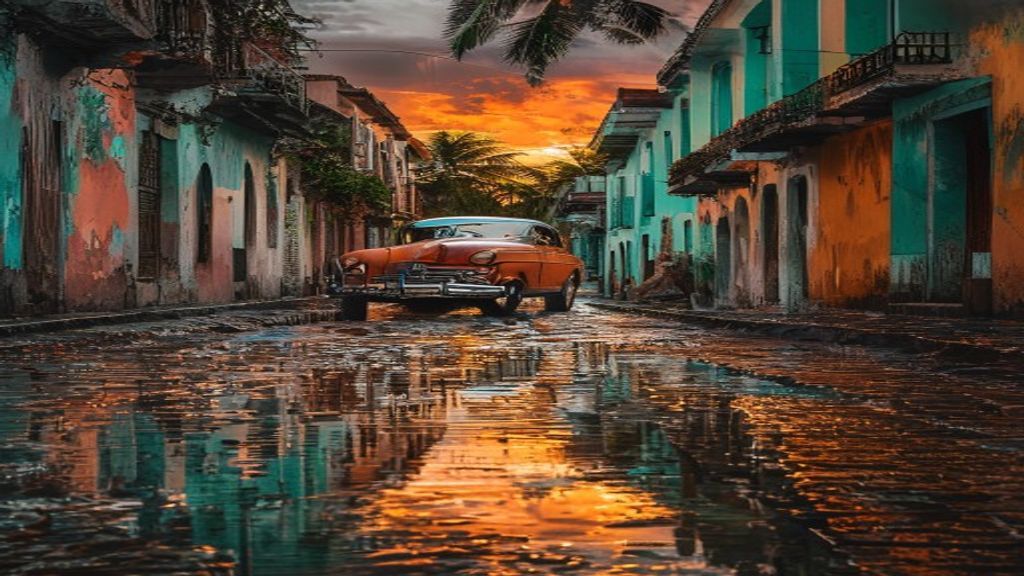
There is a moment in Havana — a precise and fleeting one — when the rain stops and the city remembers itself.
It arrives without announcement. The clouds, which had been stacked like bruised cotton over the Malecón, begin to part. The last drops fall in slow, fat sequences from the brim of a rusted balcony rail. And then the light returns: amber and low, the color of old rum held to a lamp.
The Malecón at Golden Hour
The seawall stretches four miles along Havana’s northern edge, and after rain it belongs to no one — and to everyone. The promenade glistens. Saltwater and rainwater pool together in the cracks of the concrete, reflecting a sky that has turned, improbably, the color of a ripe mango. To the west, the sun sinks toward the Straits of Florida with the slow drama of something that knows it is being watched.
The Malecón smells of brine and diesel and something floral that has no name. It is the smell of Havana itself — layered, contradictory, impossible to hold.
Habana Vieja: A City Preserved in Amber
Walk inland from the seawall and the streets narrow. The colonial architecture of Old Havana — its facades peeling in long, baroque strips of turquoise and ochre and rose — catches the post-storm light and glows. Every building here is a palimpsest. Spanish arches frame doorways. A 1955 Chevrolet, burgundy and enormous, idles at a corner, its chrome bumper throwing light in every direction like a small, captured sun.
The cobblestones of Plaza Vieja are still dark with rain. Puddles map the uneven ground in still, perfect rectangles of reflected sky. A pigeon lands at the edge of one, studies its reflection, and flies away.
Time moves differently in this light. The city’s famous disrepair — the cracked stucco, the colonnade missing half its columns — looks, in this hour, less like decay and more like wisdom. As if the buildings have simply lived long enough to stop pretending.
Rooftops at Dusk
Climb to any rooftop in Centro Habana as the dusk deepens and you will understand why painters have always come here. The city spreads below in a mosaic of terra cotta and faded paint. Television antennas rise from flat roofs like the masts of sunken ships. In the distance, the lighthouse at El Morro blinks its patient rhythm over the harbor entrance, once, twice, once again.
The Caribbean sky performs its nightly theater. Clouds that were menacing an hour ago are now sculptural, backlit in violet and deep coral. The air has cooled to something almost merciful. Somewhere below, a trumpet begins — a single, exploratory phrase — and then finds its melody.
What the Rain Leaves Behind
Havana after rain is not a postcard. It is something rawer and more honest than that. It is a city that has weathered every kind of storm — political, economic, meteorological — and emerged each time not unscathed but unbroken. The beauty here is never easy or uncomplicated. It asks something of you. It asks you to sit with contradiction: magnificence and ruin, music and hardship, color and shadow.
But in that golden hour after the clouds part, when the wet streets shine and the old cars drift through pools of amber light and the sea wall glitters against a sky on fire — in that hour, Havana offers itself completely.
And it is more than enough.