Dust and Gold: The Sahara at Dusk
As the sun falls behind the dunes of the Moroccan Sahara, the desert abandons its ferocity and reveals something unexpectedly tender — a landscape of shifting light, impossible silence, and infinite, humbling scale.
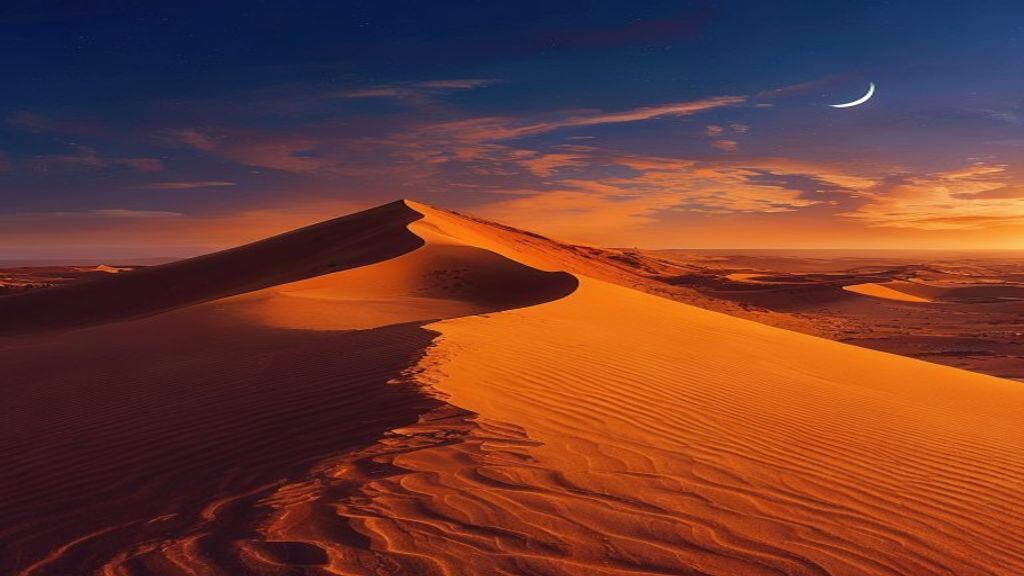
No photograph ever quite explains the Sahara. You can see pictures of the dunes — their famous curves, the way light carves shadow into their faces — and still arrive entirely unprepared for the physical fact of them. They are not scenery. They are a presence.
Four in the Afternoon: The Desert Wakes
All day, the Erg Chebbi dunes have sat under a hammering sun, pale and washed out, their colors bleached to a near-white gold. Travelers shelter in their desert camps and wait. But as four o’clock approaches and the sun begins its long, slow descent toward the horizon, something shifts. Shadows appear — first just at the base of the dunes, thin and tentative, then growing longer and darker with startling speed. The sand turns. Ivory becomes amber. Amber becomes copper. Copper, by degrees, becomes something between rust and fire.
The wind picks up slightly, just enough to lift a thin veil of sand from the ridge lines, sending it trailing like smoke off a slow-burning fire. The dunes appear to breathe.
Climbing the Ridge
The climb to the top of a large dune is a negotiation. Two steps up, one step back as the sand gives way beneath your feet in soft, soundless avalanches. Each handhold on the steep face leaves a perfect impression that the wind immediately begins to erase. By the time you reach the ridge — that impossibly sharp line between the lit side and the shadow side — your lungs ache and your legs burn, and none of it matters.
The view from the top is a reckoning. The desert extends in every direction, dune behind dune behind dune, each one a slightly different hue — gold, ochre, sienna, a distant range fading to mauve at the horizon. The silence is not the absence of sound so much as the presence of something much older and larger than sound. It presses gently against your ears.
The Last Light
Ten minutes before sunset, the colors reach their peak in a kind of slow detonation. The western face of every dune catches the last horizontal light and ignites — not orange, not red, but something richer and stranger, a color that exists only in this place at this hour. The shadows on the eastern faces go the deep, cool blue of twilight. The sky above grades from gold at the horizon through tangerine to a clear, vertiginous indigo overhead.
A crescent moon, thin as a fingernail paring, appears almost without announcement above the eastern dunes. Venus follows moments later. The desert does not acknowledge the transition. It simply changes, as it always has, as it will long after every witness is gone.
After Dark: The Stars Arrive
The temperature drops with a speed that is almost aggressive — fifteen degrees in thirty minutes. But with it comes the Sahara’s other great gift: a sky so dark and so clear that the Milky Way is not a suggestion but a solid, luminous river overhead. Stars appear at the horizon as well as the zenith. The constellations seem too close, too bright, almost theatrical in their clarity.
A fire crackles somewhere in the camp below. The smell of woodsmoke and harira soup drifts upward. And the dunes, now blue-black and silver in the moonlight, are as beautiful in darkness as they were in the burning afternoon gold — different, but equally vast, equally indifferent, equally extraordinary.
This is what the desert teaches, if you are willing to sit still long enough to hear it: that the world existed in astonishing beauty long before anyone arrived to name it.