Zhangjiajie: The Floating Mountains of China
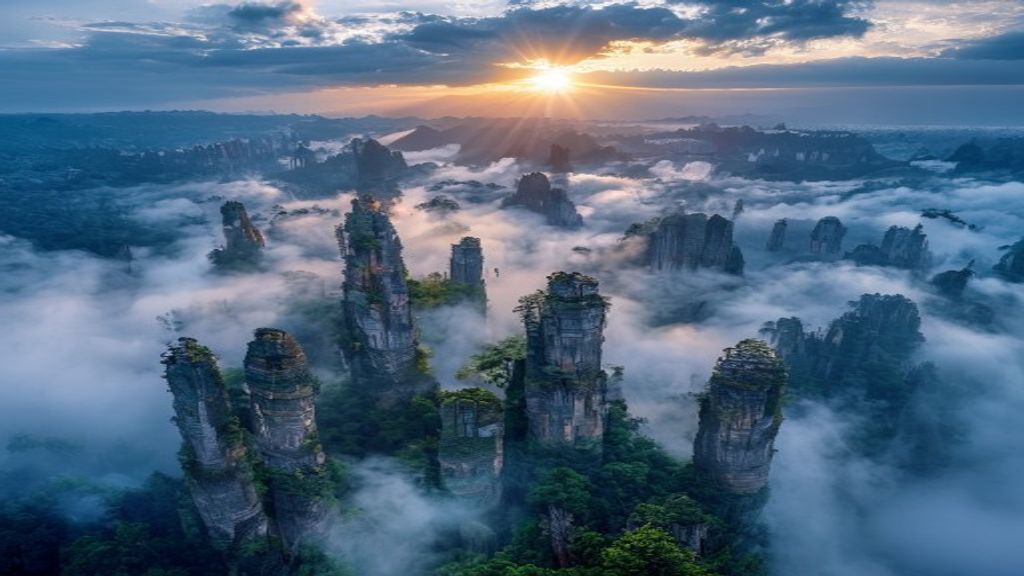
The pillar-like sandstone peaks of Zhangjiajie rise so dramatically from the mist that they inspired the floating Hallelujah Mountains of Avatar — and standing among them in person is even more surreal than the film. This remote corner of Hunan Province is one of the most visually alien landscapes on the face of the Earth.
Zhangjiajie: The Floating Mountains of China
There are landscapes that look digitally enhanced even when you’re standing inside them. Zhangjiajie, located in the Hunan Province of south-central China, is one of those places. More than 3,000 quartzite sandstone pillars erupt from the valley floor, some stretching over 200 meters into the sky, their sheer sides draped in subtropical forest and permanently wreathed in ribbons of cloud. It’s no accident that James Cameron’s team named their alien world after these peaks — nothing on Earth looks quite like this.
Designated a UNESCO World Heritage Site as part of the Wulingyuan Scenic Area in 1992, Zhangjiajie remains surprisingly underexplored by international travelers, with the majority of visitors being domestic Chinese tourists. That means infrastructure is world-class, prices are reasonable, and the experience is both accessible and authentic.
What Makes Zhangjiajie Special
The defining feature of the park is its Avatar Hallelujah Mountain — officially renamed in 2010 in honor of the film — a 1,080-meter pillar that seems to defy gravity. But one dramatic column does not define a place. The Tianzi Mountain Nature Reserve offers ridge-top viewpoints where you look down at a thousand pillars emerging from white sea-mist like a fever dream, while the Yuanjiajie Plateau gives you a bird’s-eye perspective across the entire canyon system.
For the adventurous, the Tianmen Mountain Glass-Bottom Skywalk — a transparent walkway cantilevered over a sheer 1,430-meter cliff face — is the most heart-pounding walk you’re likely to ever take. The cable car up to Tianmen Mountain is itself a spectacle: at 7.5 kilometers, it’s the world’s longest passenger cable car, ascending through a vertical wall of forest and fog.
Then there’s the Bailong Elevator (Hundred Dragons Elevator): a glass-sided outdoor lift that climbs 326 meters up a sheer cliff face and is listed as the world’s tallest and heaviest outdoor elevator. It sounds like a gimmick — it is absolutely not.
Best Time to Visit
April through June and September through November are the prime seasons. Spring brings fresh greenery and wildflowers; autumn turns the forest a warm amber and crimson. The misty conditions that make the pillars look so ethereal are most reliable in spring and early summer, when low clouds roll through the valley at dawn. Avoid Chinese national holidays (especially Golden Week in early October) as domestic crowds can be overwhelming.
Must-See Spots
- Yuanjiajie Scenic Area — The plateau viewpoints that directly inspired Avatar; unmissable at sunrise
- Tianmen Mountain & Glass Skywalk — A vertiginous glass ledge over a 1,400-meter drop — breathtaking in every sense
- Bailong Elevator — Ride the world’s tallest outdoor elevator up a sheer sandstone cliff
- Jinbian Stream (Golden Whip Stream) — A peaceful 7.5km valley walk through bamboo groves and past towering columns reflected in crystal-clear water
- Yellow Dragon Cave — One of China’s largest karst cave systems, with an underground river and stalactite cathedral chambers
Practical Tips
- Getting there: Fly into Zhangjiajie Hehua International Airport (DYG) with connections from Beijing, Shanghai, Chengdu, and Guangzhou. High-speed rail links also connect to Changsha.
- Getting around: The park is vast — use the internal shuttle buses, cable cars, and elevators. A full exploration takes 3–4 days minimum.
- Entry: The Wulingyuan Scenic Area charges a park entrance fee (approximately ¥248/day in 2026). Purchase tickets online to avoid queues.
- Accommodation: Stay in Zhangjiajie City for budget options or book a hotel inside the park at Wulingyuan Town for direct early morning access before day-trippers arrive.
- Language: English signage is improving but limited. Download an offline Chinese translation app before you go.
- Photography: Bring a wide-angle lens and wake up early. The first two hours after dawn, when mist fills the valleys, are when the magic is most intense.
Zhangjiajie is the rare destination that does not disappoint its hype. If anything, standing at the edge of a cliff as a thousand stone towers dissolve into white mist below you, it becomes clear that no photograph — not even a Hollywood blockbuster — can fully prepare you for this place.