Socotra: The Alien Island at the Edge of Arabia
Off the Horn of Africa floats an island so biologically isolated that a third of its plant life exists nowhere else on Earth — including the surreal, umbrella-shaped Dragon Blood Tree that looks like it was drawn by a science fiction artist. Socotra, Yemen's remote jewel, is one of the most extraordinary places on the planet.
Socotra: The Alien Island at the Edge of Arabia
If you were to design a planet for a fantasy novel, you might conjure something like Socotra. Located in the Arabian Sea roughly 240 kilometers east of the Horn of Africa, this Yemeni archipelago has been so geographically isolated for so long — separated from the Arabian Peninsula some 20 million years ago — that evolution ran its own wild experiments here, producing landscapes that trigger a double-take in even seasoned travelers.
Socotra is a UNESCO World Heritage Site and one of the most biodiverse islands on Earth. Around 37% of its plant species, 90% of its reptile species, and 95% of its land snail species are found nowhere else in the world. Walking through its interior feels less like travel and more like trespassing on another planet.
What Makes Socotra Special
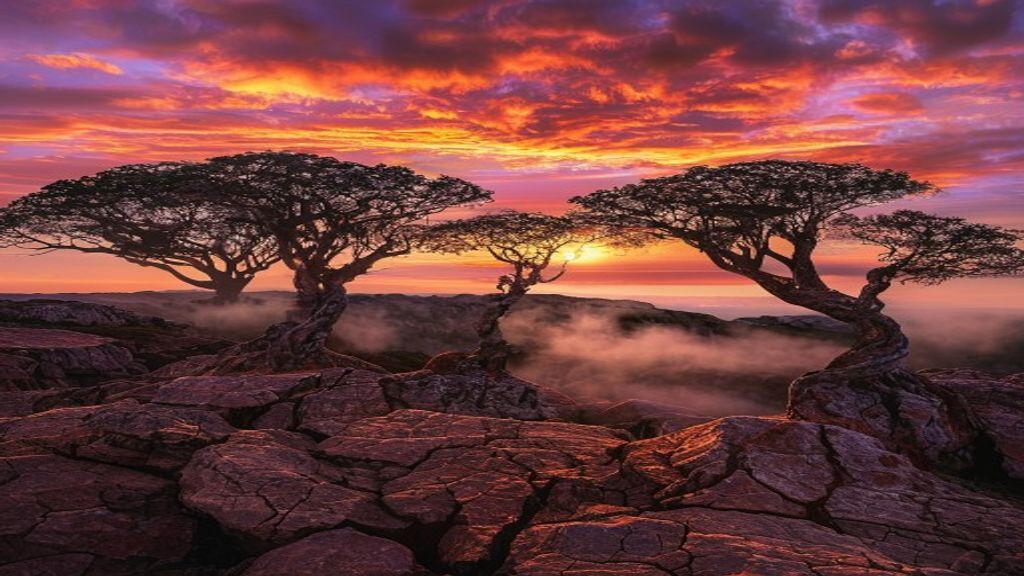
The star of the show is the Dragon Blood Tree (Dracaena cinnabari), an ancient species with a dense, flat canopy that looks like a mushroom cloud frozen in wood. Forests of these otherworldly trees blanket the Dixam Plateau, their twisted silver trunks rising from rust-red rock in a scene of absolute biological strangeness. Cut the bark and a deep crimson sap bleeds out — the source of the island’s mythological name.
Beyond the trees, Socotra delivers desert dunes that spill into turquoise lagoons, limestone cave systems adorned with stalactites, and white-sand beaches so remote that the only footprints on them are likely your own. Detwah Lagoon near the western tip is a protected nature reserve where flamingos wade through glassy shallows at dawn.
The Socotri people — descendants of ancient South Arabian settlers — speak a language with no written form, one of the world’s rarest linguistic survivors. Their hospitality is as disarming as their island is strange.
Best Time to Visit
Socotra’s weather is defined by its monsoon. October through April is the only viable window for visitors — the skies are clear, the winds are gentle, and the island is accessible by air. From June to September, the summer khareef monsoon brings violent winds that ground all flights and close the island entirely. Plan accordingly — and plan well in advance.
Must-See Spots
- Dixam Plateau — the densest Dragon Blood Tree forest on the island, hauntingly beautiful at sunrise
- Detwah Lagoon — a turquoise coastal lagoon teeming with birdlife and framed by dunes
- Hoq Cave — a vast limestone cave system with stalactites, ancient inscriptions, and cathedral-sized chambers
- Qalansiyah Beach — one of the finest remote beaches in the Arabian Sea, powdery white and utterly empty
- Hadibo Market — the island’s modest capital, where Socotri frankincense, dried fish, and dragon blood resin are traded
Practical Tips
- Getting there: Flights operate from Abu Dhabi and Sharjah (UAE) and from Sana’a or Mukalla (Yemen) during the dry season. The UAE route is far more accessible for international travelers.
- Visas: Tourism is officially managed; most visitors arrive on organized tours that handle permits and logistics. Independent travel is extremely difficult.
- Accommodation: Options range from basic guesthouses in Hadibo to wild camping under the Dragon Blood Trees — the latter being the more magical choice.
- Connectivity: Mobile and internet coverage is limited. Embrace the disconnection.
- Responsible travel: Socotra’s ecosystem is fragile. Stay on marked paths, do not collect plants or rocks, and use only established local guides.
Socotra does not ease you in. From the moment the Dragon Blood Trees appear through your plane window, you know you’ve arrived somewhere that doesn’t follow the rules — and that’s precisely the point.