Socotra Island: Yemen's Alien Eden at the Edge of the Arabian Sea
Socotra's otherworldly Dragon Blood Trees, white sand beaches, and turquoise lagoons look like something conjured from a science-fiction novel — yet this remote Yemeni archipelago is entirely, astonishingly real. Isolated from the mainland for millions of years, it has evolved one of the most unique ecosystems on the planet.
Socotra Island: Yemen’s Alien Eden at the Edge of the Arabian Sea
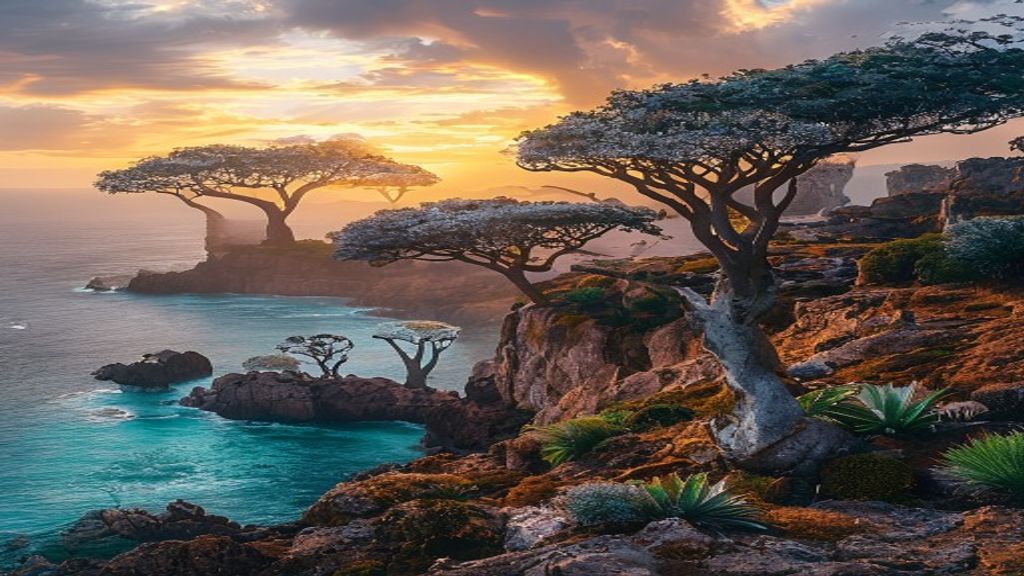
Imagine a landscape where umbrella-shaped trees with silver trunks bleed crimson resin, where limestone plateaus dissolve into white-powder beaches lapped by waters so clear they appear lit from within, and where one-third of all plant life exists nowhere else on Earth. This is Socotra — a UNESCO World Heritage Site, a biological treasure vault, and one of the most visually extraordinary destinations on the planet.
Located in the Arabian Sea roughly 240 km east of the Horn of Africa and 380 km south of the Arabian Peninsula, Socotra belongs to Yemen but feels like a world entirely its own. Its extreme isolation over millions of years has produced an evolutionary experiment unlike anywhere else — earning it the nickname “The Galápagos of the Indian Ocean.”
What Makes Socotra Special
The island’s defining icon is the Dragon Blood Tree (Dracaena cinnabari) — an impossibly geometric tree whose dense, flat-topped canopy looks like a giant inside-out umbrella. When cut, it weeps a vivid red resin that has been prized since antiquity as a pigment, medicine, and magical substance. Groves of these trees crown the Haghier Mountains and the Dixam Plateau, where fog drifts between their alien silhouettes at dawn in scenes of genuinely surreal beauty.
Socotra’s coastline is equally spectacular. Qalansiyah Lagoon in the northwest is one of the most beautiful beaches in the entire Arabian Peninsula — a tranquil arc of white sand sheltering a turquoise lagoon from the open sea. The Detwah Lagoon nearby is a flamingo habitat and a perfect kayaking ground. Along the northern coast, Dihamri Marine Protected Area offers snorkeling among pristine coral reefs and abundant marine life largely untouched by commercial fishing.
The island’s culture is equally unique. The indigenous Socotri people speak a language unrelated to standard Arabic — an ancient South Semitic tongue with no traditional written form, still passed down orally through poetry and song.
Best Time to Visit
Timing is critical on Socotra. The summer monsoon (June–September) renders the island almost completely inaccessible, with flights suspended and seas too dangerous for boats. The ideal window is October through May, with the peak sweet spot falling in November through February, when temperatures are mild (25–30°C), winds calm, and the landscape at its most vivid after the rains. March and April bring more visitors and the Dragon Blood Trees look spectacular against clear blue skies.
Must-See Spots
- Dixam Plateau — The most accessible Dragon Blood Tree forest, best explored at sunrise when mist weaves between the trees and the light turns gold.
- Qalansiyah & Detwah Lagoon — A two-lagoon system of impossible beauty; camp on the beach at night under skies unpolluted by any city light.
- Homhil Protected Area — A highland nature reserve with Dragon Blood Trees, endemic cucumber trees (Dendrosicyos socotranus), and a natural infinity pool with views to the sea.
- Wadi Dirhur Canyon — A dramatic gorge lined with endemic frankincense trees and bottle trees (Dorstenia gigas), perfect for hiking.
- Hadhibo (Hadibo) — The island’s modest capital, where the central market sells frankincense, aloe vera, and dragon blood resin alongside everyday Socotri life.
Practical Tips
- Getting there: Yemenia Airways and Felix Airways operate flights from Abu Dhabi, Cairo, and Sana’a to Socotra’s airport in Hadhibo. Confirm current schedules well in advance — routes change seasonally.
- Visas & Safety: Socotra is administered by the UAE-backed Yemeni government and has been largely insulated from the mainland conflict. Visitors typically need a Yemeni visa; check your government’s current travel advice before booking.
- Getting around: There is no public transport. Hiring a 4WD with a local driver-guide is essential and is best arranged through a reputable Socotra-based tour operator.
- Accommodation: Options range from simple guesthouses in Hadhibo to community campsites and eco-lodges in nature areas. Camping under the stars is the quintessential Socotra experience.
- Responsible travel: Socotra’s ecosystem is fragile. Stay on established paths, never remove plants or rocks, and patronize local guides and guesthouses to ensure tourism benefits the island community directly.
Socotra is not an easy destination — it demands flexibility, research, and a spirit of genuine adventure. But for those who make the journey, it offers something increasingly rare in 2026: a landscape that looks like no other place on Earth, and an encounter with nature in its most original, uncompromised form.