Socotra: The Alien Island at the Edge of the Arabian Sea
Rising from the Arabian Sea like a fragment of another planet, Yemen's Socotra Island is home to dragon blood trees, frankincense groves, and white sand dunes — an ecosystem so bizarre and isolated that a third of its plant species exist nowhere else on Earth. This is nature at its most otherworldly, and one of travel's great remaining frontiers.
Socotra: The Alien Island at the Edge of the Arabian Sea
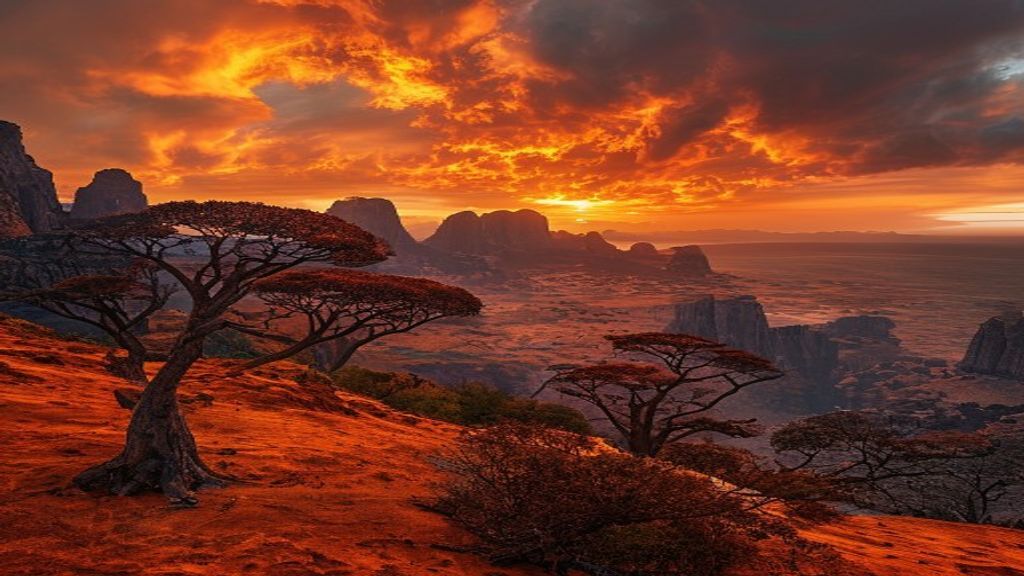
There are places that look like Earth, and then there is Socotra. Sitting 240 kilometers off the Horn of Africa in the Arabian Sea, this Yemeni island — a UNESCO World Natural Heritage Site — feels like a location designer’s fever dream. Dragon blood trees fan their surreal mushroom-shaped canopies against crimson sunsets. Bottle trees bulge comically from barren limestone plateaus. Desert roses bloom in granite crevices. And brilliant white dunes drift toward turquoise lagoons so clear you can count every grain of sand beneath the surface.
Socotra has been isolated — by ocean, by geography, by time — for so long that evolution ran entirely its own experiment here. The result is one of the most biodiverse islands on the planet, with roughly 37% of its plant species, 90% of its reptiles, and 95% of its land snails found nowhere else on Earth. Biologists call it the “Galápagos of the Indian Ocean.” Travelers who’ve made it here call it the most extraordinary place they’ve ever stood.
What Makes Socotra Unmissable
The icon of Socotra is the Dracaena cinnabari — the dragon blood tree — named for the vivid crimson resin it bleeds when cut. Its inverted umbrella silhouette, evolved to collect coastal fog in an arid environment, looks like something from a fantasy novel. The densest forests of these trees are found on the Dixam Plateau, where thousands of them create a surreal alien canopy stretching to the horizon.
Beyond its alien botany, Socotra rewards the adventurous traveler with pristine beaches (Detwah Lagoon, Qalansiyah, and Aomak are among the most beautiful in the entire Arabian Peninsula), stunning granite mountain ranges rising to 1,500 meters in the Haggier Mountains, and a warm, famously hospitable Socotri people whose ancient, unwritten language — related to no other living tongue — is as unique as the landscape itself.
The island’s isolation has preserved it in remarkable amber. There are no international chains, no resort complexes, no crowds. Camping under skies so dark the Milky Way casts shadows is a nightly event.
Best Time to Visit
Socotra’s notorious monsoon season (June–August) essentially cuts the island off from the world — the airport closes and seas become impassable. The prime travel window is October through May, with November through March offering the most stable weather, calm seas, and comfortable temperatures (25–30°C). Early spring is particularly magical when wildflowers bloom across the plateau.
Must-See Spots
- Dixam Plateau — The heartland of the dragon blood tree forest; hauntingly beautiful at sunrise.
- Detwah Lagoon — A vast, sheltered turquoise lagoon backed by white sand dunes; world-class snorkeling.
- Haggier Mountains — Multi-day trekking through frankincense groves and endemic granite landscapes.
- Hoq Cave — A vast cavern containing ancient inscriptions from Indian, Greek, and South Arabian mariners dating back 2,000 years.
- Qalansiyah Beach — Often cited as one of the finest beaches in all of Asia; dunes meet calm crystalline water in a natural harbor.
Practical Tips
- Getting there: Fly into Socotra Airport (SCT) via Aden or Seiyun (Yemen). Several charter operators fly from Abu Dhabi, Cairo, and Djibouti during the tourist season. Check current political conditions and entry requirements carefully.
- Permits: A Yemeni visa and special island entry permit are required. Arrange these through a licensed local tour operator — do not attempt independent entry.
- Accommodation: Options are rustic — local guesthouses and tented camps. Embracing this is essential to the experience.
- Guides: A local Socotri guide is mandatory by law and invaluable in practice — they know the terrain, speak the language, and provide irreplaceable cultural context.
- Responsible travel: Socotra’s ecosystem is fragile and increasingly threatened by climate change. Stay on marked trails, take nothing, and book operators who adhere to eco-tourism principles.
- Connectivity: Minimal. Tell someone your itinerary before you go, and embrace the digital detox.
Socotra does not accommodate the casual tourist. It rewards the curious, the patient, and the adventurous with an encounter with a world that evolution built separately — and that still feels impossibly, miraculously apart.