Rajasthan Beyond the Golden Triangle: India's Desert Kingdom
Venture past Jaipur, Agra, and Delhi into the raw heart of Rajasthan — where fortress cities rise from sand and every town wears a different color.
The Land of Kings, Unfiltered
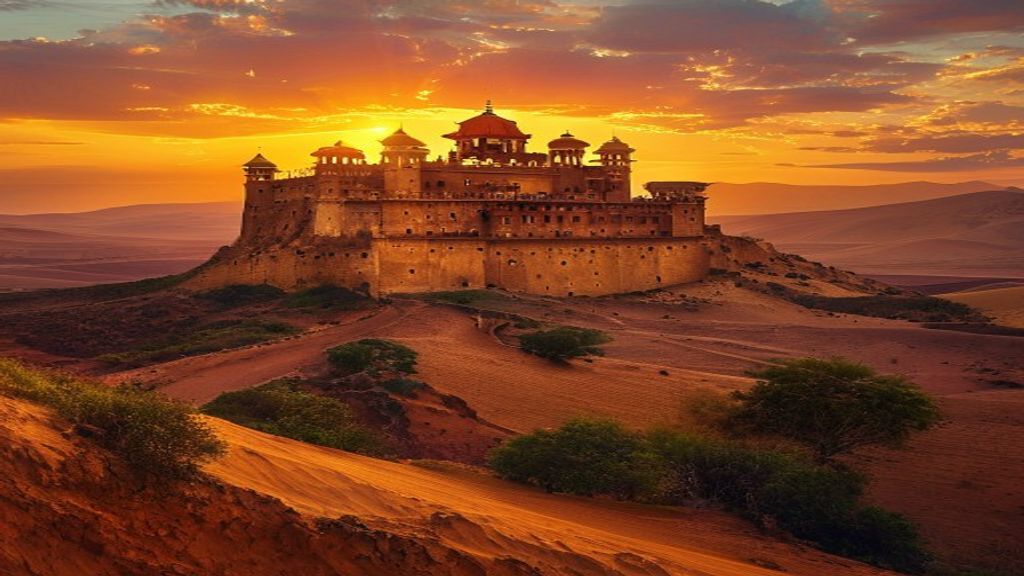
The Golden Triangle — Delhi, Agra, Jaipur — is a fine introduction to India. But it is an introduction, not the story. The real Rajasthan begins where the tour buses turn around, in the western desert where Mehrangarh Fort erupts from a sheer cliff face, where the blue city of Jodhpur pools at its base like fallen sky, and where the Thar Desert stretches to the Pakistan border in an ocean of rippled sand.
Jodhpur — The Blue City
Every travel photograph of Jodhpur’s old city looks manipulated. It is not. Seen from the ramparts of Mehrangarh Fort, the city below is a sea of indigo — houses painted blue in a tradition variously attributed to Brahmin caste marking, insect repellent properties of the copper sulphate-laced whitewash, or simply the desire to reflect the punishing desert heat. Whatever the reason, the effect is staggering.
Mehrangarh itself is arguably India’s most magnificent fort. Its walls rise 120 meters from the rocky ridge, and inside you will find intricately carved sandstone lattice screens so fine they look like lace, mirror-inlaid chambers that scatter candlelight into galaxies, and a collection of royal palanquins that redefine the word “opulent.”
Insider tip: Visit the fort at opening (9 AM) or in the late afternoon golden hour. The midday heat and crowds both peak between noon and three.
Jaisalmer — The Golden City
Further west, where Rajasthan dissolves into the Thar Desert, Jaisalmer’s massive sandcastle fort rises from the dunes like a mirage that refused to vanish. This is one of the world’s last living forts — roughly 3,000 people still reside within its walls, in havelis (merchant mansions) whose sandstone facades are carved with a delicacy that borders on the obsessive.
Walk through the narrow lanes and you will pass Jain temples from the 12th century, their marble interiors carved so deeply that columns appear translucent. At sunset, climb to the fort’s western ramparts and watch the entire structure glow amber, then copper, then the deep gold that gives the city its name.
The Sam Sand Dunes, forty kilometers west, offer the classic camel safari experience. But for something quieter, hire a jeep to the Khuri dunes instead — fewer tourists, better stars, and the chance to stay in a village mud-hut guesthouse run by families who have navigated this desert for generations.
Pushkar — The Sacred Lake
Pushkar is small, vegetarian, alcohol-free (officially), and utterly magnetic. The town wraps around a lake that Hindus consider one of the most sacred in India, ringed by fifty-two ghats (stone staircases descending to the water) and over four hundred temples. The only Brahma temple in the world draws pilgrims year-round.
But Pushkar’s real draw for travelers is its atmosphere — a strange, compelling blend of deep spirituality and backpacker bazaar. Sadhus meditate on the ghats at dawn while shops selling tie-dye and silver jewelry open their shutters behind them.
If you can time it: The Pushkar Camel Fair in November is one of India’s most extraordinary spectacles — 50,000 camels, horse races, mustache competitions, and a level of sensory chaos that is uniquely, magnificently Indian.
Bundi — The Secret One
Tucked into a narrow valley in southeastern Rajasthan, Bundi gets a fraction of the visitors that its beauty deserves. The town is crowned by Taragarh Fort and anchored by the Garh Palace, whose interior walls are covered in some of Rajasthan’s finest miniature paintings — turquoise, gold, and vermilion scenes of royal hunts, monsoon celebrations, and celestial beings.
Bundi’s stepwells are the real treasure. The Queen’s Stepwell (Raniji ki Baori) descends through multiple levels of carved stone, each tier more elaborate than the last. In the morning light, the geometry of shadow and stone is almost hypnotic.
Getting Around
- Trains are the best way to travel between Rajasthani cities — book AC classes on the Indian Railways website
- Hire a driver for multi-city trips; it is affordable and saves enormous logistical headaches
- October to March is peak season with comfortable temperatures; summer (April-June) sees 45°C heat that is genuinely dangerous
- Dress modestly at temples and rural areas, carry a scarf for impromptu head coverage