The Namib Desert: Earth's Oldest Wilderness at the Edge of the Sea
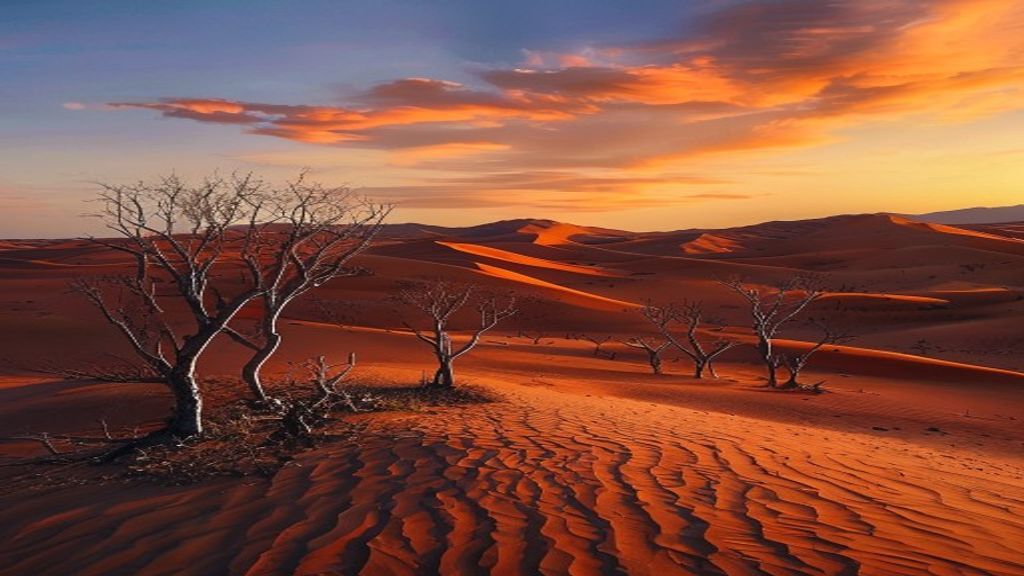
The Namib is the oldest desert on earth — over 55 million years of wind-sculpted silence — where blood-red dunes taller than skyscrapers meet the cold Atlantic surf and fog-shrouded ghost towns rust quietly in the sand. It is one of the most visually staggering places on the planet.
The Namib Desert: Earth’s Oldest Wilderness at the Edge of the Sea
There are deserts, and then there is the Namib. Stretching 2,000 kilometers along the Atlantic coast of Namibia, this is the oldest desert on earth — a place so ancient and so extreme that it has evolved creatures found nowhere else, shaped landscapes of almost impossible drama, and preserved ghost towns swallowed by sand like a slow-motion apocalypse.
For travelers willing to make the journey, the Namib delivers a confrontation with scale and silence that is almost impossible to describe. Standing atop a dune at sunrise, watching the shadow play across ridgelines that stretch to the horizon, is the kind of experience that reorders your sense of the world.
What Makes the Namib Extraordinary
At Sossusvlei in the Namib-Naukluft National Park, the dunes reach heights of 300–400 meters — among the tallest in the world. At dawn, they shift through a palette of deep orange, burnt sienna, and rose pink that no photograph fully captures. The legendary Dune 45 and the colossal Big Daddy are landmarks on the bucket lists of photographers and adventurers alike.
Nearby, Deadvlei is perhaps the most otherworldly landscape on the continent: a white clay pan studded with the 900-year-old blackened skeletons of camelthorn trees, long dead but preserved by the extreme aridity, set against apricot dunes and a hard blue sky. It looks like a surrealist painting.
On the coast, the Skeleton Coast earns its ominous name from the bleached bones of whales and seals — and the wrecks of ships that foundered on the treacherous, fog-shrouded shore. Eerie and magnificent in equal measure.
Further south, the ghost town of Kolmanskop was once a diamond boom town; today its grand German colonial buildings are half-buried in drifting dunes, their interiors silted with sand.
The Desert’s Unique Wildlife
The Namib supports an astonishing cast of desert specialists. The Namib fog beetle harvests moisture from Atlantic sea fog on its bumpy back. Oryx stalk the dune seas. Welwitschia plants — some over 1,500 years old — survive on virtually nothing. Along the skeleton coast, enormous Cape fur seal colonies number in the hundreds of thousands, drawing black-backed jackals and brown hyenas to the shoreline.
Best Time to Visit
May through October (Namibia’s dry winter) is the ideal time: cooler temperatures, clear skies, and the lowest humidity. Sunrise visits to Sossusvlei are non-negotiable — arrive before the gate opens at 5:30am to catch the dunes in their most spectacular light. Avoid December–February when temperatures can exceed 45°C in the dune valleys.
Must-See Spots
- Deadvlei — The dead camel thorn trees against apricot dunes are unmissable at sunrise.
- Dune 45 & Big Daddy — Climb before 8am before the heat becomes prohibitive.
- Kolmanskop Ghost Town — Book a morning access tour from nearby Lüderitz.
- Swakopmund — The charming German colonial coastal town is an excellent base; try quad biking on the dunes at sunset.
- Spitzkoppe — Dramatic granite inselbergs rising from the gravel plains, with some of Namibia’s best rock art.
Practical Tips
- Getting there: Fly into Windhoek (Hosea Kutako Airport) with connections through Johannesburg, Frankfurt, or Dubai. Self-drive is the best way to explore — Namibia has excellent, well-signed gravel roads.
- Car rental: A 4WD is highly recommended for dune access roads. Book well in advance during peak season.
- Accommodation: Desert Camp and Sossusvlei Lodge offer stunning lodges near the dune entrance. Budget travelers can camp at NWR sites inside the park.
- Safety: Carry far more water than you think you need. Dune climbing is strenuous — start before sunrise. Fuel up in every town; distances between stations are vast.
- Leave no trace: The Namib’s ecosystem is extraordinarily fragile. Stay on designated paths and never remove rocks, plants, or sand.